

Prefer to listen to a human conversation?
Paid subscribers: claim CME here
A patient sent Sonia an Instagram reel. In it, a physician explained, with total confidence, that mammograms cause more cancers than they prevent, that they don’t really save lives, and that women should rethink whether they’re getting them at all.
What stood out wasn’t the reel. It was who sent it. This patient was sharp and health-literate, the kind of person who reads past the headline. A lot of my friends are talking about this, she wrote, and they seem to believe it. What do you think?
The answer at the time was fairly simple: there’s good evidence for mammograms, I’d like you to keep getting them, and I’m happy to talk through your specific risks and concerns. That answer still stands. But the question hasn’t gone away. Both of us have some version of this conversation about once a month, usually right around a patient’s 40th birthday. And when we searched “mammograms” in a podcast app while preparing this episode, nearly every one of the top results promised some version of the dirty truth or what your doctor isn’t telling you about mammograms.
So we went back and did the deep dive. What we found is more nuanced than either the reels or the reflexive reassurance tends to suggest, and honestly, some of it surprised us.
In this first part of a two-part series, we’re asking: are mammograms doing more harm than good? (In Part 2, we’ll look at the alternatives being marketed in their place.)
The Claim
If you spend time on social media or in podcast apps, you’ve probably come across some version of this message: mammograms aren’t what you’ve been told.
The most common claim is that mammograms cause breast cancer, because they expose sensitive breast tissue to ionizing radiation. In its strongest form, the claim is that they cause more cancers than they prevent. A related and more visceral claim is that compressing a breast that contains a hidden tumor can rupture it and spread cancer cells.
Then there are the claims aimed at specific groups of women: that mammograms simply don’t work if you have dense breasts, so they may be fine for “the masses” but not for you.
And finally, the most sophisticated claim: that mammograms don’t actually save lives. They just find more cancer, including slow-growing cancers and pre-cancers that would never have caused harm, and turn healthy women into cancer patients. At its most cynical, this becomes a story about a medical system that needs patients in order to profit.
The message that ties all of this together is appealing: find the right imaging for you. Why put up with something uncomfortable that involves radiation, when there might be something painless and radiation-free instead?
Why It’s Going Viral
Start with the obvious: breast cancer is common, and it is frightening. It’s the most common cancer in US women. About 1 in 8 women (roughly 13%) will be diagnosed with invasive breast cancer in her lifetime, which means almost all of us know someone who has been through it. Incidence has also been rising, with steeper increases in women under 50 and in Asian American and Pacific Islander women. When a disease feels this close, any information about how to catch it, or how the tools to catch it might hurt us, gets our full attention.
Mammograms are also not a fun experience. The common description is that it feels like putting your breast in a vise, and the waiting can be harder than the squeezing. (For what it’s worth, Sonia had her first mammogram this year, made a day of it with a friend on her 40th birthday, and both of them walked out saying it was much gentler than they’d braced for. Not everyone has that experience, but it’s worth knowing it’s possible.)
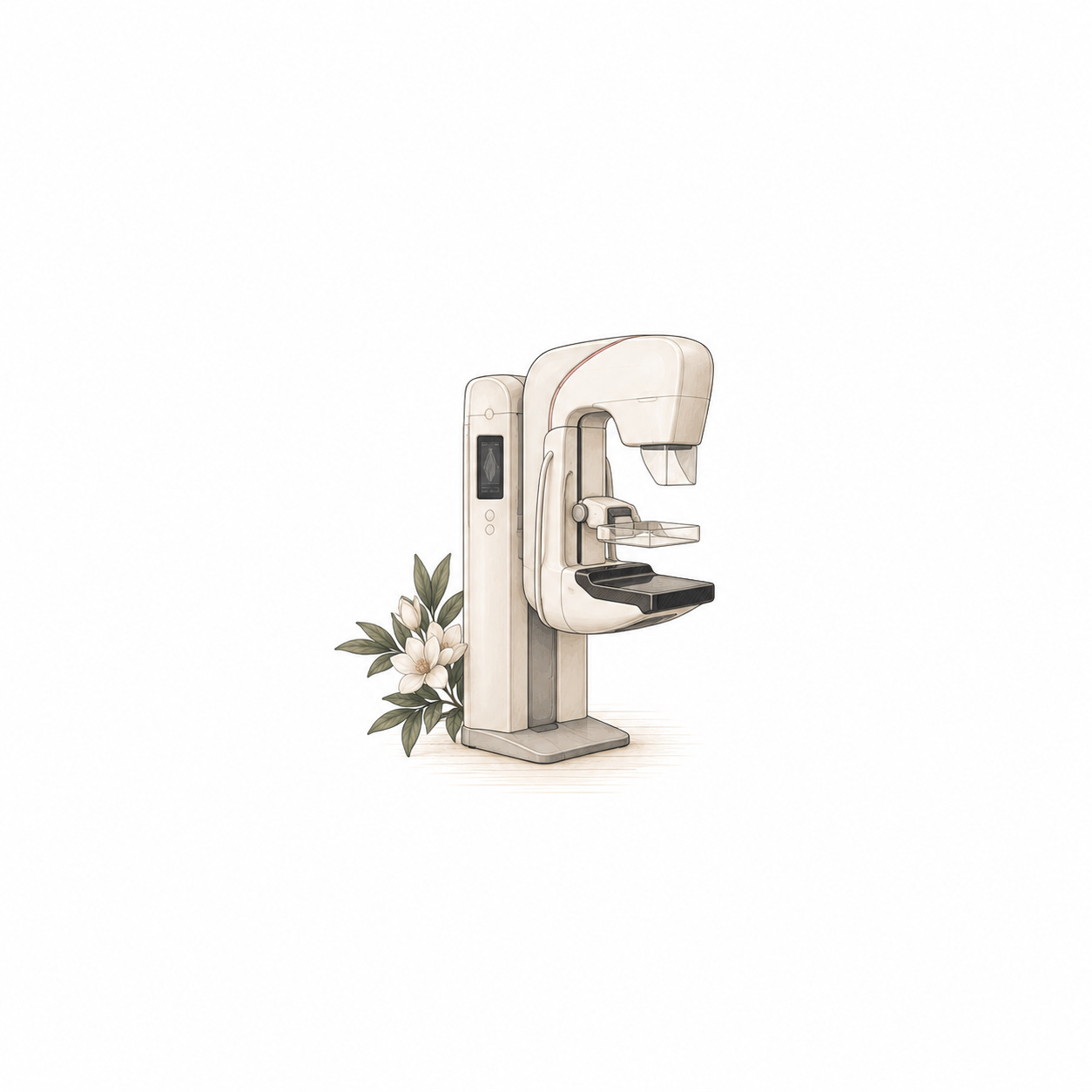
There’s also a growing and very valid recognition that women’s health has been understudied and underfunded for a long time, and that women’s pain during medical procedures has gone unacknowledged and untreated. When a friend of ours looked at the mammogram machine and thought, this is all you’ve got?, she was voicing something a lot of women feel. If medicine has neglected women’s health in other ways, it’s reasonable to wonder whether better technology exists and just hasn’t been prioritized.
Layered on top of that is anxiety about radiation. Many people already feel surrounded by exposures they can’t see, and the idea of a healthy person who feels completely fine voluntarily taking on any risk can feel unacceptable. What people are looking for, understandably, is the Goldilocks test: one that catches every cancer, never gives a false alarm, causes no discomfort, and carries no risk at all. Unfortunately, that test doesn’t exist for any condition, which is exactly where alternatives can step in and say, that’s us.
Trust plays a role too. Since the pandemic, many people have questioned whether they can rely on medical recommendations. Add to that a broader “Medicine 3.0” narrative suggesting that what insurance covers is the cheap, outdated option, while the cutting-edge, safer options are available only to those who can pay out of pocket.
Finally, there’s the issue of dense breasts. Radiology reports are now required to tell women when they have dense breast tissue, along with a notice that mammography is less sensitive in dense breasts and that density is associated with higher cancer risk. What the report doesn’t include is a clear next step, because there isn’t a universally agreed-upon, consistently covered plan for these patients. It is left to “shared decision-making.” Being told that you have higher risk and that your screening test works less well, with no clear path forward, would leave anyone scared and searching for answers.
What the Science Shows
Let’s start with the nugget of truth, because there is one. Mammograms are not perfect. No screening test is perfectly sensitive or perfectly specific, and like every medical intervention, mammograms carry real risks and harms. They do expose you to ionizing radiation. There is no dose of radiation that we can say is completely risk-free. Women, especially younger women, appear more sensitive to radiation than men, and breast tissue is particularly sensitive. And there is genuine, ongoing debate among experts about when to start screening and how often to do it.
So the questions are legitimate. What matters is what the evidence shows when we look closely, and, importantly, who that evidence applies to.
For everyone being screened: the radiation question
A standard screening mammogram delivers about 0.4 millisieverts (mSv), the unit used to estimate biological harm from radiation. For context, people in the US absorb about 3 mSv each year just from natural background radiation, so a mammogram is roughly equivalent to six or seven weeks of everyday life. A CT scan of the abdomen and pelvis is around 7 to 10 mSv, or about 20 to 25 times more. A woman who had a mammogram every single year from age 40 to 80 would accumulate about 16 mSv, which is roughly the equivalent of two abdominal CT scans over four decades.
In large population studies, a clear increase in cancer risk shows up at around 50 mSv from a single exposure, or around 100 mSv accumulated over a lifetime. Lifetime mammography sits well below those thresholds. That doesn’t mean the risk at lower doses is zero; it probably isn’t. But it is very small, and it can only be estimated by extrapolating from higher doses. That kind of research is also full of confounders. (If people who had ten CT scans develop more cancers, you’d have to ask why they needed ten CT scans in the first place.)
Here’s the thing the reels tend to leave out: this concern isn’t new, and researchers have tried to quantify it. The most robust modeling study, published in 2016, estimated that for every 100,000 women screened annually from age 40 to 74, about 125 breast cancers and 16 breast cancer deaths might be caused by radiation, compared with about 968 breast cancer deaths prevented by screening. These are mathematical projections, not counts of real people, and they deserve a heaping spoonful of salt. But other modeling studies reach the same general conclusion: the deaths averted outnumber the deaths potentially caused by a wide margin.
(As for the idea that compression can rupture a tumor and spread cancer cells, we couldn’t find evidence to support it, and it isn’t consistent with how breast cancers actually spread.)
For women 50 to 74: the clearest benefit
Many studies show that mammography reduces the risk of dying from breast cancer. The sharpest critique of that data is that it may be inflated by three well-known biases. Overdiagnosis means finding cancers, including ductal carcinoma in situ (DCIS), that would never have caused harm. Length-time bias means screening is best at catching slow-growing cancers. Lead-time bias means earlier diagnosis can make survival look longer even if the outcome doesn’t change.
These are legitimate critiques from anti-mammogram content creators. But they aren’t new, either. Researchers have designed analyses specifically to work around them, mainly by looking at outcomes that overdiagnosis can’t easily inflate. If screening truly helps, it should reduce the number of advanced cancers that are diagnosed, and the number of fatal cancers.
That is what the data show for women over 50. A major systematic review found screening reduced advanced breast cancer in women 50 and older by about 38%. A study of more than 549,000 Swedish women found that those who were screened had a 41% lower rate of breast cancers that proved fatal within 10 years, and a 25% lower rate of advanced cancer, and the authors argue those gains were independent of improvements in treatment. A recent 21-country European study found that stage IV diagnoses declined after screening programs were introduced, with the strongest data for women 50 to 69.
What about the claim that screening trials don’t show a reduction in deaths from all causes? That part is true, and it’s one of the most frequently cited points in anti-mammogram content. But no single-cancer screening trial has ever been designed with enough participants to detect it. Breast cancer is common, but far fewer women die of it than are diagnosed, and many other conditions cause deaths in the same age range. A 20% reduction in breast cancer deaths would be expected to lower overall deaths by less than 1%, a difference that would take a trial of more than a million women to detect. The only screening trial that has shown an all-cause mortality benefit was for lung cancer screening in people who smoke, a population where the cancer is far more deadly.
For women 40 to 49: a genuine debate
This is where the evidence is honestly less settled. In the same systematic review, screening did not appear to reduce advanced cancers in women in their 40s, and European analyses found the same pattern. That is a big part of why guidelines still differ.
In 2024, the US Preventive Services Task Force moved from shared decision-making in the 40s to recommending screening every other year starting at 40. The American College of Obstetricians and Gynecologists recommends starting at 40 and screening every one to two years. The National Comprehensive Cancer Network, the American College of Radiology, and the Society of Breast Imaging recommend annual screening starting at 40. Canada’s guidelines recommend against routine screening for women in their 40s. In the UK, the NHS screens women from 50 to 71 every three years.
Notably, the shift toward starting at 40 in the US wasn’t driven by new trial data. It was driven largely by rising rates of breast cancer in women in their 40s. Reasonable experts look at the same evidence and land in different places, and that’s not a sign that anyone is hiding anything.
For women with dense breasts
It’s true that mammography is less sensitive in dense breast tissue, and it’s true that density is associated with higher breast cancer risk. But less sensitive is not the same as not working. What to add for women with dense breasts, if anything, is a real and unresolved question, and we’ll dig into supplemental imaging and the marketed alternatives in Part 2.
For women at higher risk
Everything above applies to people at average risk. A strong family history or a known genetic syndrome changes the conversation entirely, and may mean starting earlier or adding ultrasound or MRI. Risk calculators and an individualized conversation matter here.
The harms that get less airtime: callbacks, biopsies, and the waiting
Radiation gets most of the attention online, but the harms that patients are most likely to actually experience are false alarms.
About 16% of women are called back for more imaging after their first mammogram, and around 10% after later mammograms, even though most of those callbacks turn out to be nothing. Over ten years of screening starting at age 40, about 61% of women screened every year will have at least one false-positive callback, compared with about 42% of women screened every other year. About 7% of women screened annually will have a biopsy that turns out to be benign over that decade, compared with about 5% of women screened every other year.
Those numbers can sound small or large depending on how you look at them. But behind each one is something real: weeks of fear, a procedure, possible complications, and costs. Follow-up diagnostic imaging and biopsies often aren’t covered the way screening is, and every appointment can mean another day off work. For hourly workers in particular, that can be the reason someone doesn’t go back.
Sonia lived this recently. A first mammogram led to a callback, then a diagnostic result labeled “suspicious,” then three weeks of waiting for a biopsy while fairly convinced it was DCIS, then a biopsy with lingering pain and swelling, and a tiny metal marker that worked its way out of the breast eight weeks later. She would still make the same choice. Many people would. But it was not nothing, and it shouldn’t be treated as nothing.
Clinical Nuance
When a patient brings a reel like this to a clinic visit, there’s a tempting response, and it’s one many clinicians recommend: Mammograms are safe and effective, and they save lives. Period. We understand where that comes from. In a polarized information environment, it can feel like any nuance creates room for doubt.
But the doubt is already there. When someone brings us a question, they are opening a door, and closing it quickly risks sending them to someone who will happily spend 45 minutes telling them how scary this is and that their doctor never mentioned it. Acknowledging that mammograms have real harms, and that the evidence in the 40s is genuinely debated, doesn’t weaken the case for screening. It builds the trust that makes the rest of the conversation possible.
That conversation is what shared decision-making actually looks like. Guidelines exist because it isn’t realistic for every clinician, or every patient, to read and synthesize decades of trials and modeling studies. We rely on panels of experts in epidemiology, statistics, and breast imaging to do that, and the fact that they don’t all agree is a sign of independent thinking, not a conspiracy. A list of PubMed links in a reel isn’t the same as a careful synthesis of the full body of evidence.
But guidelines are where the conversation starts, not where it ends. A useful question is: Which sounds harder to you: getting called back, maybe having a biopsy, and finding out it was benign, or finding a lump a year from now that could have been caught earlier? Some patients will tell you right away that they’re doing every other year. Others are asking at 39 and a half whether they can schedule early. Both are reasonable, and neither is ours to decide. Family history, personal risk tolerance, and values all belong in that conversation, and structured decision aids can help when time, health literacy, or language barriers make it harder.
It’s also worth being honest about where everyone’s perspective comes from. Radiologists and breast specialists see the advanced cancers that might have been caught earlier, and that understandably shapes their recommendations. Primary care clinicians worry about missed diagnoses, too. Health systems with tighter budgets screen less often. None of these perspectives is purely about money, and none of them is purely neutral.
And one of the simplest ways to reduce harm costs nothing: anticipatory guidance. Telling a patient before her first mammogram that about 1 in 6 people get called back, and that most callbacks turn out to be nothing, can turn a panicked phone call into a calm one.
The Antidote
Affirmations for Patients
It makes sense that I’m scared of breast cancer. It’s common, and most of us have watched someone we love go through it.
I can ask hard questions about mammograms without being “anti-mammogram.”
Wanting a screening test with no risks at all is human. No test is perfect, and that’s okay.
If I get called back, that’s common, especially after a first mammogram. A callback is not a diagnosis.
Seeing “dense breasts” on my report is information, not an emergency.
If and how often I get screened is a decision I get to make for myself with the guidance of my clinician.
A confident video with a lot of links is not the same as the whole body of evidence.
I don’t have to choose between trusting my doctor and asking questions.
Language Clinicians Can Use
“I’m really glad you brought this up. Let’s talk about what we know, what we don’t know, and what matters most to you.”
“Mammograms aren’t perfect. No screening test is. Here’s what they can and can’t do.”
“There is a small amount of radiation, about the same as six or seven weeks of everyday life. Researchers have looked closely at whether that outweighs the benefit, and it doesn’t come close.”
“About 1 in 6 people get called back after their first mammogram, and most of those turn out to be nothing. If you get that call, try not to panic.”
“In your 40s, the evidence is honestly less clear, and reasonable experts disagree. That’s exactly why your preferences matter here.”
“Which sounds harder to you: a callback or biopsy that turns out to be benign, or finding something later that might have been caught earlier?”
“Your family history changes this conversation. Let’s look at your individual risk before we decide on a plan.”
Resources and where to learn more
Structured shared decision making tools: https://www.aafp.org/fpm/2017/0500/p5 https://decisionaid.ohri.ca/docs/das/opdg.pdf
Giaquinto AN, Sung H, Newman LA, et al. Breast Cancer Statistics 2024. CA: A Cancer Journal for Clinicians. 2024.
https://pubmed.ncbi.nlm.nih.gov/39352042/Orrall A. Breast Cancer Incidence Still Rising Despite Decline in Death Rates. JAMA. 2024.
https://jamanetwork.com/journals/jama/fullarticle/10.1001/jama.2024.22056National Comprehensive Cancer Network. NCCN Guidelines: Breast Cancer Screening and Diagnosis. Updated 2026.
https://www.nccn.org/professionals/physician_gls/pdf/breast-screening.pdfUS Preventive Services Task Force, Nicholson WK, Silverstein M, et al. Screening for Breast Cancer: US Preventive Services Task Force Recommendation Statement. JAMA. 2024.
https://jamanetwork.com/journals/jama/fullarticle/10.1001/jama.2024.5534Anderer S. ACOG Now Recommends Breast Cancer Screenings Start at Age 40. JAMA. 2024.
https://jamanetwork.com/journals/jama/fullarticle/10.1001/jama.2024.23048Expert Panel on Breast Imaging, Yeh ED, Brown A, et al. ACR Appropriateness Criteria® Female Breast Cancer Screening: 2025 Update. Journal of the American College of Radiology. 2025.
https://linkinghub.elsevier.com/retrieve/pii/S1546-1440(25)00498-3Qaseem A, Harrod CS, Balk EM, et al. Screening for Breast Cancer in Asymptomatic, Average-Risk Adult Females: A Guidance Statement From the American College of Physicians (Version 2). Annals of Internal Medicine. 2026.
https://www.acpjournals.org/doi/10.7326/ANNALS-25-05116Duffy SW, Offman J. A Guide to Cancer Screening. Nature Reviews Clinical Oncology. 2026.
https://www.nature.com/articles/s41571-025-01112-zKhan M, Chollet A. Breast Cancer Screening: Common Questions and Answers. American Family Physician. 2021.
https://www.aafp.org/pubs/afp/issues/2021/0101/p33.htmlHendrick RE. Radiation Doses and Cancer Risks From Breast Imaging Studies. Radiology. 2010.
https://pubmed.ncbi.nlm.nih.gov/20736332/Kerut EK, To F. Risk of Low-Level Ionizing Radiation from Medical Imaging Procedures. Echocardiography. 2011.
https://onlinelibrary.wiley.com/doi/10.1111/j.1540-8175.2011.01433.xAmerican Cancer Society. Understanding Radiation Risk from Imaging Tests.
https://www.cancer.org/cancer/diagnosis-staging/tests/imaging-tests/understanding-radiation-risk-from-imaging-tests.htmlBrenner DJ, Doll R, Goodhead DT, et al. Cancer Risks Attributable to Low Doses of Ionizing Radiation: Assessing What We Really Know. Proceedings of the National Academy of Sciences. 2003.
https://pubmed.ncbi.nlm.nih.gov/14610281/Miglioretti DL, Lange J, van den Broek JJ, et al. Radiation-Induced Breast Cancer Incidence and Mortality From Digital Mammography Screening: A Modeling Study. Annals of Internal Medicine. 2016.
https://pubmed.ncbi.nlm.nih.gov/26756460/Mannu GS, Wang Z, Dodwell D, et al. Invasive Breast Cancer and Breast Cancer Death After Non-Screen Detected Ductal Carcinoma In Situ From 1990 to 2018 in England: Population Based Cohort Study. BMJ. 2024.
https://pmc.ncbi.nlm.nih.gov/articles/PMC10806881/Nelson HD, Fu R, Cantor A, et al. Effectiveness of Breast Cancer Screening: Systematic Review and Meta-Analysis to Update the 2009 U.S. Preventive Services Task Force Recommendation. Annals of Internal Medicine. 2016.
https://pubmed.ncbi.nlm.nih.gov/26756588/Cardoso R, Ola I, Jansen L, et al. Breast Cancer Incidence, by Stage at Diagnosis, and Mortality in 21 European Countries in the Era of Mammography Screening: An International Population-Based Study. The Lancet Regional Health – Europe. 2026.
https://pmc.ncbi.nlm.nih.gov/articles/PMC12803884/Autier P, Boniol M. Mammography Screening: A Major Issue in Medicine. European Journal of Cancer. 2018.
https://pubmed.ncbi.nlm.nih.gov/29272783/Duffy SW, Tabár L, Yen AM, et al. Mammography Screening Reduces Rates of Advanced and Fatal Breast Cancers: Results in 549,091 Women. Cancer. 2020.
https://pubmed.ncbi.nlm.nih.gov/32390151/Heijnsdijk EAM, Csanádi M, Gini A, et al. All-Cause Mortality Versus Cancer-Specific Mortality as Outcome in Cancer Screening Trials: A Review and Modeling Study. Cancer Medicine. 2019.
https://onlinelibrary.wiley.com/doi/10.1002/cam4.2476Miglioretti DL, Abraham L, Sprague BL, et al. Association Between False-Positive Results and Return to Screening Mammography in the Breast Cancer Surveillance Consortium Cohort. Annals of Internal Medicine. 2024.
https://pmc.ncbi.nlm.nih.gov/articles/PMC11970968/Allison KH, Abraham LA, Weaver DL, et al. Trends in Breast Biopsy Pathology Diagnoses Among Women Undergoing Mammography in the United States: A Report From the Breast Cancer Surveillance Consortium. Cancer. 2015.
https://pubmed.ncbi.nlm.nih.gov/25603785/Hubbard RA, Kerlikowske K, Flowers CI, et al. Cumulative Probability of False-Positive Recall or Biopsy Recommendation After 10 Years of Screening Mammography: A Cohort Study. Annals of Internal Medicine. 2011.
https://pubmed.ncbi.nlm.nih.gov/22007042/