


Prefer to listen to a human conversation?
Patient Story
Three patients. Three continuous glucose monitors. Three very different outcomes.
One patient — uninsured, and as a result diagnosed with diabetes far later than he should have been — had been stuck at an A1C of 8 despite being on multiple medications. He bought an over-the-counter CGM online, started wearing it on his own, and finally got his A1C down into the low sevens for the first time.
Another patient, newly diagnosed with prediabetes and hepatitis due to fatty liver disease, started working with a dietitian who recommended a CGM alongside his dietary changes. Over about four months, watching how different foods and behaviors moved his glucose helped bring his A1C and liver enzymes back down to completely normal.
And a third patient, in treatment for an eating disorder, had a CGM placed to watch for dangerous drops in blood sugar. Instead, the alarms that went off after meals became a trigger. She noticed her glucose looked “better” when she didn’t eat — and she started skipping the meals her treatment team had prescribed.
Same device. Same stream of data. Wildly different results.
So the question worth asking isn’t really “are CGMs good or bad?” It’s “who actually benefits from wearing one — and who might be harmed by it?”
The Claim
If you spend time on wellness or health social media, you’ve probably seen continuous glucose monitors (CGMs) — the small sensors people wear on their upper arm — marketed with some version of these ideas:
Tracking your glucose continuously can help you “optimize” your health.
Your CGM will tell you which foods, and which diet, are actually right for your body.
Glucose spikes are harmful and need to be avoided.
A CGM can find evidence of a metabolic problem before standard lab tests would catch it.
Wearing a CGM will help you lose weight.
The pitch is appealing precisely because it sounds so personalized: instead of generic advice, you get real-time, individual feedback about your own body.
Why It’s Going Viral
The emotional truth underneath this trend is real, and it’s worth naming before we get into the evidence.
We’re living in the middle of optimization culture. There’s a growing belief that more data automatically means better decisions — and for the first time, glucose data that used to require a painful fingerstick can now be collected continuously and turned into a beautiful, shareable graph. That’s a powerful shift, and companies (and the telehealth and coaching businesses built around them) have been quick to market it.
There’s also the appeal of personalization versus generic healthcare. A CGM promises advice tailored to your body specifically, not the same recommendations your doctor gives everyone else. For patients who’ve felt rushed, dismissed, or unheard by the medical system — that promise resonates.
Then there’s the fear of a hidden illness. Social media surrounds us with stories of people who seemed healthy until they weren’t, and metabolic health in particular has become a highly visible, sometimes politicized, focus of the wellness world. In some corners of that world, blood sugar has become a kind of boogeyman — the explanation for fatigue, brain fog, and nearly everything else — and sugar itself has been cast as one of the most dangerous substances in the modern diet. If that’s the starting premise, then monitoring glucose around the clock feels like the obvious solution.
None of this makes someone gullible for being curious about a CGM. Wanting more insight into your own body is a deeply human impulse. It’s exactly why this conversation deserves nuance instead of a simple yes or no.
What the Science Shows
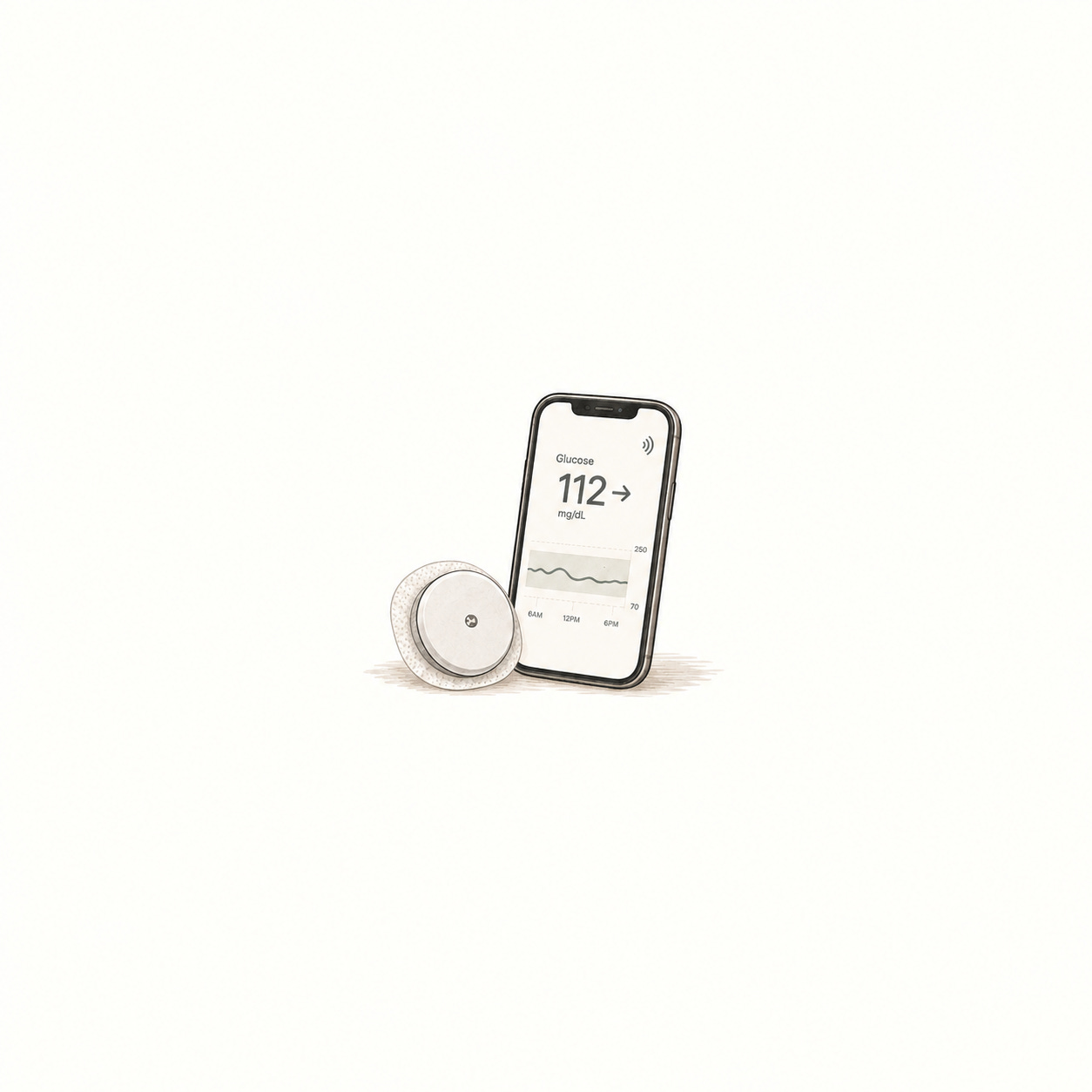
First, a quick primer on what a CGM actually measures. A small sensor, usually worn on the upper arm, uses a tiny filament to measure glucose in the interstitial fluid — the fluid between your cells — not your blood directly. Because the interstitial fluid and the bloodstream take time to equilibrate, CGM readings lag behind an actual blood glucose by roughly five to twenty minutes, especially when your glucose is changing quickly. Prescription CGMs report a new reading every one to five minutes; over-the-counter models measure about as often but only report every fifteen minutes and don’t have low-glucose alarms.
Readings can also be thrown off by things that have nothing to do with your actual glucose: sleeping on the sensor and compressing it, dehydration, intense exercise, certain medications (high-dose vitamin C, hydroxyurea, and acetaminophen (Tylenol) in older generation devices), a poorly placed sensor, or simply the first 24 hours after a new sensor goes on. In other words, a scary-looking number on your phone isn’t always a scary number in your blood.
Who actually benefits — the evidence, by population:
Type 1 and Type 2 diabetes, on insulin: This is where the evidence is strongest. Meta-analyses of randomized trials show CGM use modestly lowers A1C (roughly 0.17–0.35%), increases time spent in target range, and reduces time spent dangerously high or low. Real-world data from the VA also linked CGM use to fewer hypoglycemia-related ER visits and hospitalizations.
Type 2 diabetes, not on insulin: Randomized trials in this group also show a consistent benefit — improved A1C, more time in range, and reduced healthcare utilization — even without insulin in the picture.
Prediabetes / metabolic syndrome: A 2025 systematic review found CGM use improved average blood glucose and was associated with better dietary adherence and behavior change in people with prediabetes. Notably, it found no appreciable glycemic benefit in people with already-normal blood sugar, and no significant effect on BMI in this population overall.
Healthy, normoglycemic adults: There is essentially no evidence base here. We don’t even have agreed-upon target ranges for glucose fluctuation in people who don’t have a metabolic condition, which makes it genuinely unclear what a CGM would be optimizing toward. There is no data showing CGM use improves energy, brain fog, or fatigue in this group.
Eating disorders: This is an emerging and actively studied area, not an established one. Small studies show that most patients with anorexia experience clinically significant, often unrecognized hypoglycemia — in one study, 91% had at least one glucose reading below 70, with patients spending an average of about 21% of the day hypoglycemic. Researchers are exploring whether CGM data could help identify dangerous lows or verify a patient’s actual food intake. But there is currently no evidence that monitoring improves outcomes, and real clinical experience — including the patient described above — shows it can also reinforce restriction by turning reactive post-meal glucose dips into a source of fear.
It’s also worth being precise about what a “spike” even means. A glucose rise after eating that returns to baseline within a normal window is expected, healthy physiology — it is not evidence of harm. What matters clinically is whether glucose returns to baseline appropriately, not whether it moved at all. Chasing ever-smaller fluctuations within an already-normal range isn’t something the evidence supports, and in people who have been chronically restricting carbohydrates, reintroducing them can cause an exaggerated insulin response and a real, if harmless, post-meal dip — the physiologic opposite of a metabolic problem.
The harms are real too, and they’re not evenly distributed. Case reports describe patients hospitalized for hypoglycemia work-ups triggered by artifactual low readings (often from compressing the sensor overnight) that didn’t reflect their actual blood sugar. A cross-sectional study of CGM users found that more than two-thirds reported fear of type 2 diabetes when they saw elevated readings, and that younger age, higher BMI, higher agreeableness, and existing eating-disorder symptoms were all associated with greater CGM-related distress — despite most of the same participants reporting that they’d made “positive” dietary changes because of the device. In other words, the people most often encouraged to try a CGM for weight or health optimization may also be the people most likely to experience it as distressing, and potentially to develop disordered patterns around it.
Clinical Nuance
None of this means a CGM is inherently good or bad. It means the question isn’t “should everyone use one,” it’s “does this specific person, with this specific history and this specific goal, stand to benefit more than they stand to be harmed?”
For someone with diabetes or prediabetes working alongside a clinician or registered dietitian, a CGM can provide genuinely useful, real-time feedback that supports medication adjustments and behavior change — often best used for a defined period of months to learn patterns, rather than indefinitely. For someone with a history of disordered eating, high health anxiety, or a tendency toward obsessive tracking, the same device can become a vehicle for exactly the behaviors we’re trying to avoid. And for someone with normal blood sugar hoping a CGM will reveal a hidden illness, explain their fatigue, or drive weight loss, the evidence simply does not show that.
A CGM interpreted without guidance — by an internet coach, an algorithm, or an AI chatbot that will cheerfully validate whatever you ask it — is a very different tool than one used with a clinician or dietitian who can put the data in context, flag artifacts, and notice if the emotional relationship to the numbers is becoming a problem. The device itself is neutral. What matters is the support system around it, and the honest answer to the question: what am I actually going to do with this information?
The Antidote
For Patients
Wanting more insight into my body is not irrational, and it doesn’t make me gullible.
A glucose spike after eating does not mean that something is wrong with me.
More data is not automatically better data — what matters is whether this tool is helping me feel more at ease in my body, not less.
If tracking something tends to pull me toward obsession or fear, it’s okay to say so and choose not to track it.
Before I buy an optional device, I deserve to know who it’s actually been shown to help — and whether that applies to me.
If I use a CGM, I don’t have to use it forever. Learning for a season and then setting it down is a completely reasonable plan.
For Clinicians
“I understand why this feels appealing — a lot of people are looking for more personalized information about their health.”
“A spike that comes back down to baseline normally isn’t something we have evidence to be worried about.”
“The question isn’t just whether this device gives us more information. It’s whether that information is going to change what we do — or just generate more anxiety.”
“If you notice yourself getting more rigid or fearful around food because of this data, I want to know that, and it’s a reason to stop, not push through.”
“Let’s use this for a defined period to learn your patterns, with a dietitian in the loop, rather than indefinitely.”
“Our goal isn’t just more information. It’s information that actually improves how you feel and how you’re doing.”