

Prefer to listen to a human conversation?
A patient recently told Sonia something that sounded small at first.
“I don’t even know what to eat for breakfast anymore.”
She wasn’t trying to lose weight. She wasn’t starting a new diet. She just wanted breakfast to stop feeling stressful.
She liked yogurt. But now there were too many questions.
Full fat or nonfat? Too much sugar? Artificial sweeteners? High protein? Hormone-friendly? Clean? Inflammatory?
Every option felt like a potential mistake.
When Sonia gently asked where all this information was coming from, the answer wasn’t a textbook or a doctor.
It was her feed.
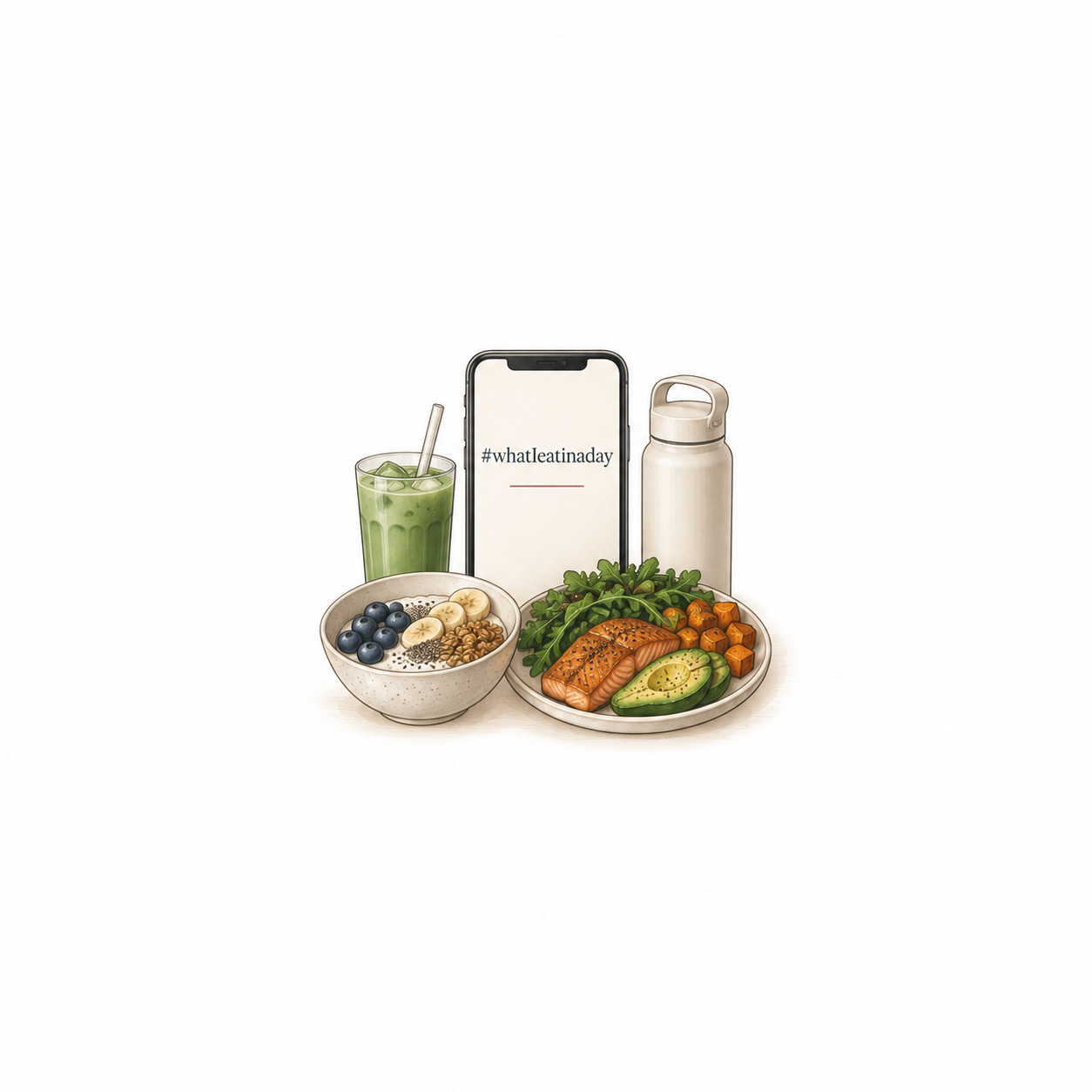
She’d been watching #WhatIEatInADay videos. Not intentionally, at first. They just started appearing. Influencers sharing beautifully plated meals. “Realistic.” “Balanced.” “For hormone health.” “For gut healing.” “For fat loss.” “For PCOS.” “For busy moms.”
She wasn’t trying to copy anyone exactly. But slowly, without realizing it, she had absorbed a new standard.
And suddenly yogurt felt complicated.
That’s the quiet power of #WhatIEatInADay.
So let’s slow down and ask the bigger question:
Is it actually helpful to know what someone else eats in a day?
The claim
Unlike some viral health trends, the claim here is rarely shouted.
It’s implied.
The format is simple: someone walks you through their meals and snacks across a day. Often there’s more layered in — a workout, a supplement routine, a productivity montage, a body shot, a skin routine.
And the framing usually sounds like this:
“What I eat in a day as a woman balancing hormones.”
“What I eat in a day postpartum trying to lose baby weight.”
“What I eat in a day managing PCOS naturally.”
“What I eat in a day as a fat person not trying to lose weight.”
The underlying message often becomes:
If you want what I have — my body, my energy, my results — this is how you should eat.
And subtly:
What you eat in a day says something about who you are.
Not just your health. Your identity.
Why this is so viral
Before we critique it, we want to validate something important:
There’s a reason this content resonates.
Humans are wired to be interested in other humans. We are social creatures. Eating has always been communal — families, villages, cultures gathering around food.
But increasingly, we’re eating alone.
Data from the World Happiness Report (2025) show that in the United States, about one in four adults reported eating all of their meals alone the previous day — a significant increase over the last two decades, especially among young people.
When shared meals decrease, watching someone else eat may feel like connection.
There’s also aspiration.
If we see someone whose body or lifestyle we admire, it’s natural to assume their habits are the key. Copy the inputs, get the outputs.
And then there’s the algorithm.
Social media doesn’t just show you what you search for. It learns what holds your gaze — even for a few seconds — and gives you more. Food, bodies, routines, transformation narratives. Slightly more intense each time.
What begins as curiosity can quietly become comparison.
Most people watching these videos aren’t trying to be extreme. They’re trying to feel certain.
The nugget of truth
There is something useful here.
Seeing how someone structures meals can reduce decision fatigue. It can make feeding yourself feel doable in a busy season. It can spark ideas.
For someone newly postpartum, newly diagnosed with a chronic condition, or overwhelmed by conflicting advice, an example can feel grounding and make an overwhelming new normal feel doable.
And yes — some creators share thoughtfully and transparently.
But there are two important caveats:
First, what someone eats in one day may not reflect what they eat most days. Filming changes behavior. Social media rewards aesthetics and certainty- so there is certainly editing involved to grab the algorithm’s attention.
Second, even if it is accurate, it is not transferable biology.
Two people can eat the same foods and have completely different outcomes because genetics, stress, sleep, medications, hormones, culture, and access all matter.
What the research tells us
Here’s where this conversation gets more complex.
A 2025 analysis of nutrition-related TikTok content found that a large portion lacked advertising transparency, conflict-of-interest disclosure, or balanced evidence framing. Engagement (likes, shares) did not reliably correlate with accuracy. Although "#WhatIEatInADay videos may not overtly claim to be educational nutrition content, they often imply it, and there are often conflicts behind the scenes.
That doesn’t mean everything online is wrong. It means platforms are not structured to reward nuance.
More strikingly, a 2025 experimental study in Appetite exposed college students to six minutes of short-form #WhatIEatInADay content. Compared to a non-food control condition, those exposed to lifestyle and eating videos showed increases in weight and shape preoccupation and shifts in urges related to eating disorder behaviors.
Six minutes.
That doesn’t mean everyone who watches these videos will develop disordered eating. But it does challenge the idea that this content is neutral background noise.
Another 2023 study found that the type of content consumed — particularly weight-loss–focused content — was more strongly associated with body image disturbance and disordered eating behaviors than total screen time. Notably, body positivity content did not clearly buffer these effects in that sample.
Content matters.
This is particularly important for adolescents, whose autonomy is developing while algorithms are refining.
There is also research exploring “mukbang” (videos focused on watching someone eat, often emphasizing sensory elements). Some viewers report increased loneliness and guilt. Others report feeling less alone or more able to eat.
Whether there is any causation of these responses from this content is not clear. People vulnerable to food preoccupation may seek out this content, and the content may also amplify vulnerability- both could be true. However it is worth learning more to understand the potential impact this kind of content might have.
The part that often gets missed
We’ve become accustomed to thinking of content as something we choose.
But increasingly, content chooses us.
You don’t have to search for weight-loss videos to see them. You only have to pause long enough for the algorithm to notice.
And because food is tied to identity, morality, control, and health fears, it’s particularly sticky.
We also want to gently name something about the phrase “what I eat in a day.”
It sounds neutral. Observational.
But it often functions as aspirational.
It implies that there is a correct way to eat in a day. That normal is stable. That discipline is visible. That health is aesthetic.
Real eating is messy. Variable. Cultural. Emotional. Practical. Boring some days. Joyful others.
A curated reel rarely captures that.
So… is it helpful?
Here’s the honest answer:
It depends on how it makes you feel.
If it gives you ideas and you move on without spiraling, it may be neutral or mildly useful.
If it leaves you tense, comparing, second-guessing, cutting out food groups, or feeling like your day “didn’t measure up,” that’s important information.
The biggest drivers of long-term health do not come from following a “perfect” day template every single day.
They are found in overall patterns: sleep, movement, nutrition, vaccination, social connection, mental health support, education, not smoking, moderated alcohol use.
And those rarely go viral.
The Antidote
For Patients
It makes sense that I want clarity around food.
One person’s day of eating is not a medical prescription.
Filmed food is curated food.
If content increases my anxiety, I can step back.
Health is built with patterns, not perfection.
I don’t need to earn nourishment.
A helpful check-in question:
After watching this, do I feel grounded — or more hyperaware and tense?That answer matters.
For Clinicians
“Are you concerned about how social media is affecting your relationship with food?”
“What kinds of food or body-related content are you seeing most often?”
“It makes sense that you’re looking for clarity — nutrition messaging is very noisy right now.”
“Content isn’t neutral. Even brief exposure can shape thoughts more than we realize.”
“Let’s tailor this to your life. What works sustainably for you?”
Consider direct screening with a validated eating disorder screening tool.
Sources and Further Reading
World Happiness Report 2025, Chapter 3: “Sharing meals with others: How sharing meals supports happiness and social connections” https://www.worldhappiness.report/ed/2025/sharing-meals-with-others-how-sharing-meals-supports-happiness-and-social-connections/
#WhatIEatinaDay: The Quality, Accuracy, and Engagement of Nutrition Content on TikTok
Does watching short-form #WhatIEatInADay videos impact eating disorder cognitions and urges to engage in eating disorder behaviors? An experimental investigation of TikTok
The impact of social media use on body image and disordered eating behaviors: Content matters more than duration of exposure
Mukbang and Disordered Eating: A Netnographic Analysis of Online Eating Broadcasts
The relationship between problematic Instagram use and eating disorders psychopathology: an explanatory structural equation model
Association between engagement with appearance and eating related TikTok content and eating disorder symptoms via recommended content and appearance comparisons
Wait Until 8th:
The 5 Cs of Media Use: Guides for parents from the American Academy of Pediatrics Center of Excellence on Social Media and Youth Mental Health