


Prefer to listen to a human conversation?
Paid subscribers- click here to claim your CE credit!
The Claim
A patient mentioned, almost in passing, that she checks her body composition regularly on a machine at her gym. She was using it to keep an eye on her metabolic health and to see whether her workouts were paying off.
Around the same time, Rebecca was hearing something bigger from some colleagues in obesity medicine: that body composition should be treated as a vital sign, measured as a screening test every year for every adult 18 and older.
Rebecca’s first reaction was that she didn’t agree. Her second was: let me actually look, because maybe I don’t know.
And to be fully transparent, she isn’t coming at this from the outside. She recently bought a medical-grade body composition machine for her own practice. Sonia has one on her wish list. So this isn’t a conversation about whether these machines are good or bad. It’s a conversation about what they can actually tell us, who they help, and where they might quietly cause harm.
So let’s ask the question plainly: is tracking body composition actually helpful?
The Claim
If you spend time on social media, you’ve probably seen a body composition scan pitched as the upgrade to the bathroom scale. The ads and influencer posts tend to make a few promises. A scan can reveal your “metabolic age.” It can give you the data to personalize and optimize your health plan. Skeletal muscle mass, the pitch goes, is a marker of longevity you should be tracking. And if you’re going to do this, you should skip the cheaper bioelectrical impedance (BIA) scales and go straight to a DEXA scan, because the difference between the two could “drastically change” your approach to your health.
Underneath all of it is a simple, appealing idea: the scale only tells you one number, and body composition tells you what that number is made of. For anyone who has made real changes and watched the scale refuse to budge, that idea lands.
Why It’s Going Viral
A lot of this comes back to optimization culture, a theme that runs through almost every episode we make. The more data I have, the logic goes, the more precisely I can tweak my routine toward a “perfect” version of my health.
The reports themselves are part of the pull. Body composition printouts are clean and color-coded: green for normal, yellow for borderline, red for low muscle or high fat. Many end with a single score, a “metabolic age” or a “body score.” Who doesn’t want an A+, or a gold star at the end of the day? Compare that to a lab portal full of jargon, or an office visit where you’re weighed and sent home with no explanation of what the number means. Medicine has not always done a good job of helping people understand their own bodies, and a 3D model of your body with every percentage broken out is hard to compete with.
There’s also money moving behind a lot of this content. Direct-to-consumer DEXA scans and at-home BIA scales are self-pay and generally not covered by insurance. Gyms often offer a scan for free, then follow it with a personal training package or a supplement that promises to improve your score. The scan becomes the front door to everything else being sold.
And underneath the marketing is something real: people want to understand their bodies. Bodies can feel mysterious, and the desire for more than a surface-level view of your health is completely human.
What the Science Shows
First, the nugget of truth. Body composition genuinely tells us more than BMI, which was never designed to describe an individual’s health. A person with a “normal” BMI can still have relatively low muscle mass and high visceral fat, the fat around the organs that’s most closely tied to cardiometabolic disease. A person with a higher BMI may carry a lot of that weight as muscle. Body composition can classify someone’s risk more accurately than height and weight alone, and it doesn’t carry the same stigma as a number on a scale. DEXA is also more accurate than BIA, so that part of the online claim has some truth to it.
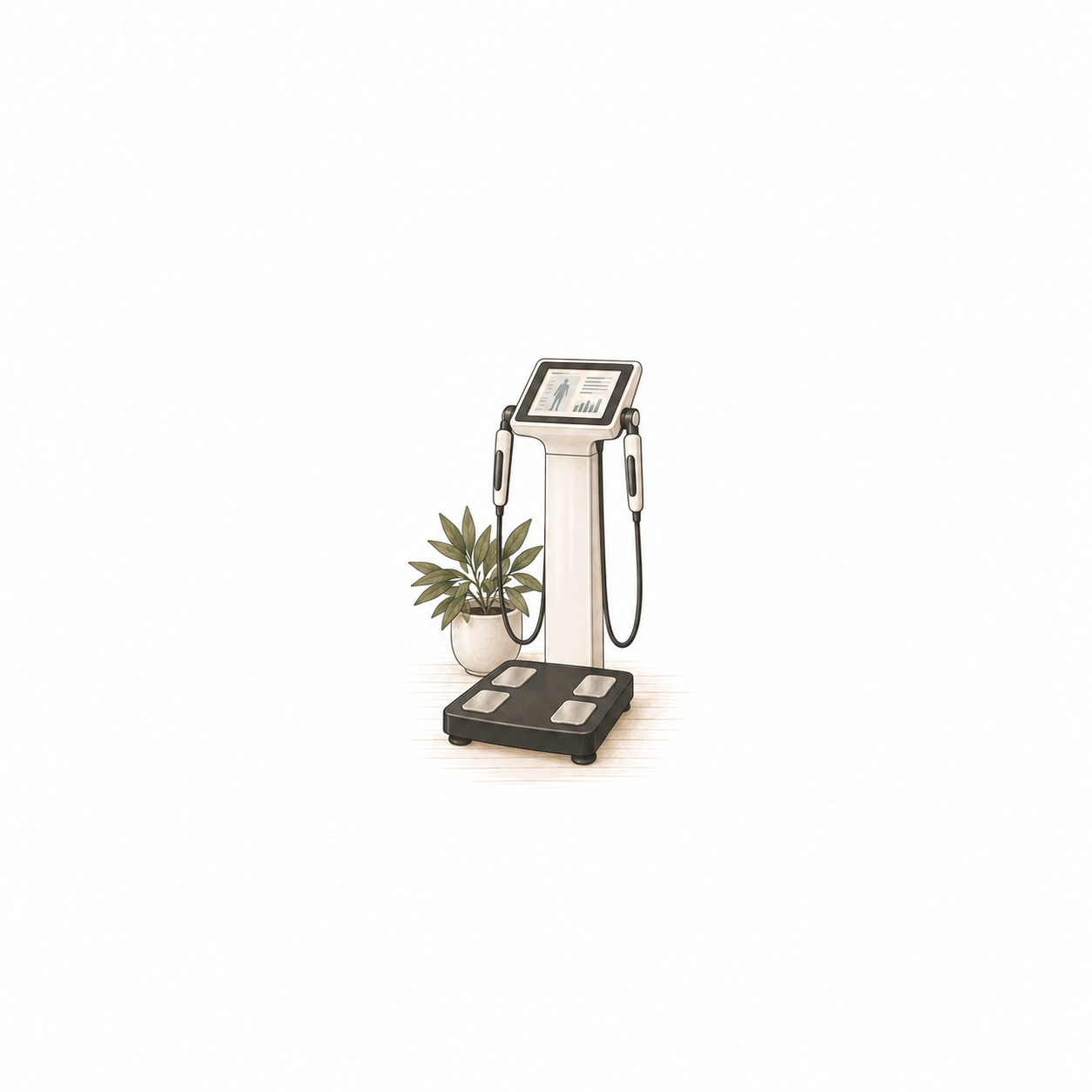
How the two main tools work. BIA sends a small electrical current through the body. Muscle and blood hold a lot of water and electrolytes, so they conduct well; fat and bone conduct poorly. The device combines that resistance with your height, weight, age and sex to estimate fat mass and fat-free mass. It’s quick, painless and can be done in an office visit, but it’s sensitive to hydration, a recent meal, recent exercise and even skin temperature. Home scales, gym machines and medical-grade devices also vary widely in accuracy. DEXA is the reference standard and very precise, but results still depend on the specific machine, model, software and positioning, so tracking over time only works on the same machine. DEXA does involve radiation, though the dose from a whole-body scan is very small, roughly what you’d receive from normal background radiation over a single day.
A harm signal worth flagging: “bone mass” is not a bone density test. Direct-to-consumer DEXA body composition scans typically report total bone mass. That is not the medical-grade bone density measurement used to diagnose osteopenia or osteoporosis, which requires specific programming and interpretation. Sonia has had patients tell her their gym scan showed normal bones, so they didn’t need a bone density test. If you were told your bone mass looked good at a gym or wellness center, that does not replace bone density testing if your doctor has recommended it.
From there, the evidence looks different depending on who we’re talking about.
For the general population (the “vital sign” question). This is where the evidence runs out. We looked for studies showing that routinely measuring body composition in people without a specific condition improves any health outcome, and didn’t find them. The 2025 VA/DoD obesity guideline lands in the same place: there are data comparing the accuracy of different measurement methods, but minimal data on whether using them actually improves clinical outcomes. A 2026 expert methodological guide in the American Journal of Clinical Nutrition adds a technical caution. Using BIA to track change over time remains problematic: individual readings can differ quite a bit from reference methods, and subtle changes in muscle or visceral fat may simply not be detectable. We were surprised by how little data exists on clinical usefulness. This isn’t new technology.
For people losing a significant amount of weight (GLP-1 medications, bariatric surgery or lifestyle change). This is where body composition has the strongest rationale. A 2026 systematic review and meta-analysis of 20 randomized trials with more than 15,000 participants found that lean mass made up roughly 25–39% of the weight lost on incretin medications, comparable to the roughly 26% seen with lifestyle interventions. The group that preserved the most lean mass was lifestyle change plus resistance training, at about 17.5%. In other words, losing a meaningful amount of weight by any route means losing some muscle, and resistance training and adequate protein help. The authors recommend body composition monitoring as part of these programs. But no study we found tested whether monitoring actually changes the outcome. Whether a “measure and adjust” strategy beats simply recommending resistance training and protein to everyone on these treatments remains untested.
For older adults living with obesity and frailty. A 2017 New England Journal of Medicine trial randomized 160 adults over 65 with obesity and mild-to-moderate frailty to a weight-management program plus aerobic exercise, resistance exercise or both, or to a control group that received general healthy-eating education only. Physical function improved most with combined aerobic and resistance exercise, and all exercise groups improved more than control. But every dieting group also lost some lean mass and hip bone density, more so with aerobic exercise alone. What the trial didn’t include is the arm Rebecca kept wondering about: exercise without the calorie deficit. We can’t tell from this study whether these older adults needed to lose weight at all, or whether exercise alone could have delivered the functional gains without the loss of muscle and bone. It’s a good example of how studies often measure how body composition changes, without asking whether measuring it, or chasing it, was the right goal.
The harms, which have barely been studied. Rebecca ran her own body composition on her new machine every day for two weeks as a test. Her body composition could not have meaningfully changed in that time frame, but the readings changed every day, and more often in a direction that looked “worse.” The report shows arrows for each metric and a falling score. She knew it wasn’t real, and it still stung. Now imagine someone who has two scans six months apart, worked hard in between, and sees no improvement. That can go two ways, and neither is good: what’s the point, nothing I do works, or I need to be stricter, which can be a path toward disordered eating. We already have strong evidence that weight stigma harms people. A 2020 meta-analysis of 30 studies found moderate associations between weight-related self-stigma and psychological distress, and between perceived weight stigma and depression. No one has studied whether visceral fat scores, muscle percentages and body scores become new versions of that stigma. Add the costs, which include cash-pay scans, repeat-visit incentives and time, and the case for routine screening gets harder to make.
Clinical Nuance
Thoughtful clinicians ask a few questions about any test: for what purpose, in whom, based on what strength of evidence, and how do the potential benefits weigh against the potential harms? A low-risk test with real potential benefit is a different calculation than one with unknown harms and unproven benefit, even if both lack perfect evidence.
By that standard, calling body composition a vital sign for every adult feels premature. It probably is a better proxy for metabolic risk than the scale or BMI, and that’s the strongest argument for it: we’re already relying on flawed metrics. But better than BMI isn’t the same as proven to help, and the potential harms haven’t been studied.
There is a compelling case for the middle ground. Think of the patient who is lifting, eating well and doing everything right, and is discouraged because the scale hasn’t moved. Or the thin patient who is sedentary, eats poorly and assumes they’re fine because their weight is “normal.” In both cases, body composition might make the conversation land differently. It’s similar to how we’ve talked about fasting insulin or perimenopause hormone levels: a test may not change medical management but may change the patient’s management, helping someone understand and buy into a plan. That’s part of the art of medicine. We just don’t have data yet showing it actually changes behavior.
Rebecca’s approach in her own practice is a working model of using the tool carefully. She chose the medical-grade BIA device with the closest agreement to DEXA she could find. She uses it mainly for patients on GLP-1 medications, where she’s intentional about slow weight loss and focuses on metabolic outcomes rather than a target number on the scale, and for patients with developing metabolic conditions. When a patient wants to keep increasing a GLP-1 dose even though their labs and blood pressure look great, knowing that their lean mass is already on the low side makes for a more honest conversation about whether that’s worth it.
She also doesn’t hand out the printout by default, because that’s where she sees the most potential for harm. If a patient asks for it, it’s their record, and they get it. Otherwise, she talks about patterns. One she sees often: people with desk jobs tend to have noticeably less muscle in their legs and torso than in their arms. That opens a collaborative conversation (a standing desk? a couple of walks during the day?) rather than “your numbers are bad.” The advice is much the same as it would have been without the scan. The difference is that it feels personal and specific, and that may be what helps it stick.
If you’re going to track over time, use the same machine under the same conditions, and remember that small changes may be noise. Notice how the numbers make you feel. If you find yourself chasing a target, getting more rigid, or wanting to give up, that’s important information too. Rebecca is curious about future uses, such as better understanding malnutrition in patients with restrictive eating disorders whose BMI looks “normal,” but she isn’t using it that way until there’s evidence it helps more than it harms.
And it’s worth asking why a practice is offering a scan. Practice owners get a steady stream of pitches for “another revenue stream.” An expensive machine with an ongoing software fee creates an incentive to scan more people, more often. That doesn’t make every scan a cash grab, but it’s fair to ask whether the test is being offered because it will help you.
The Antidote
For Patients
(Gentle reminders and affirmations)
It makes sense that I want to understand what’s happening inside my body.
My body is more than a score, and a test result is not a report card.
A body composition number is an estimate, not a verdict.
If the scale or the scan hasn’t changed, my efforts still count. Strength, energy, sleep and labs tell a story too.
Day-to-day changes in readings don’t mean I’m getting worse.
I don’t need to optimize every metric to take good care of myself.
A gym scan that says my “bone mass” looks fine is not the same as a bone density test.
If these numbers start to make me anxious, rigid or discouraged, I’m allowed to stop looking at them.
For Clinicians
(Language you can borrow, tweak, or make your own)
“I understand why this feels so much more satisfying than a number on the scale.”
“Body composition can tell us more than BMI, but we don’t have evidence yet that tracking it routinely improves anyone’s health.”
“Readings can shift with hydration, food and exercise, so small changes may not mean anything changed in your body.”
“I know you’ve been doing a lot of work. The scale isn’t the be-all, end-all, and neither is this machine.”
“Here’s the pattern I’m noticing. It makes sense given your job. What are some things we could try?”
“Your labs and blood pressure look great. Before we increase the dose of your GLP-1, let’s look at how much muscle you’re keeping.”
“That gym scan measured bone mass, not bone density. Let’s talk about whether you need a true bone density test.”
“If seeing these numbers makes you anxious or pushes you to be stricter with yourself, we don’t need to look at them. We can focus on what you’re doing.”
Sources and Further Reading
Eisa N, Barood O. Lean Mass Changes With Incretin Therapy Versus Lifestyle Intervention: A Systematic Review and Meta-Analysis of Randomised Controlled Trials. Diabetes, Obesity and Metabolism. 2026. https://doi.org/10.1111/dom.70666
Villareal DT, Aguirre L, Gurney AB, et al. Aerobic or Resistance Exercise, or Both, in Dieting Obese Older Adults. N Engl J Med. 2017;376(20):1943–1955. https://pubmed.ncbi.nlm.nih.gov/28514618/
Prado CM, Gonzalez MC, Norman K, et al. Methodological standards for body composition assessment—an expert-endorsed guide for research and clinical applications: bioimpedance, dual-energy X-ray absorptiometry, computerized tomography, and ultrasound methods. Am J Clin Nutr. 2026;123(5):101283. https://doi.org/10.1016/j.ajcnut.2026.101283
Alimoradi Z, Golboni F, Griffiths MD, et al. Weight-related stigma and psychological distress: A systematic review and meta-analysis. Clin Nutr. 2020;39(7):2001–2013. https://pubmed.ncbi.nlm.nih.gov/31732288/
U.S. Department of Veterans Affairs and Department of Defense. VA/DoD Clinical Practice Guideline for the Management of Adult Overweight and Obesity. 2025. https://www.healthquality.va.gov/HEALTHQUALITY/guidelines/CD/obesity/OBE-CPG_2025-Guideline_final_20251105.pdf