


Prefer to listen to a human conversation?
A patient recently messaged her doctor with a question that had nothing to do with the gym: “Should I be taking creatine for my brain fog and depression?”
She wasn’t an athlete. She wasn’t lifting weights. She described herself as a sweet, sedentary librarian who’d been scrolling social media and kept seeing the same message over and over: creatine isn’t just for muscle anymore — it’s for your mood, your focus, your sleep-deprived brain, maybe even your risk of dementia.
The honest first reaction was: wait, what?
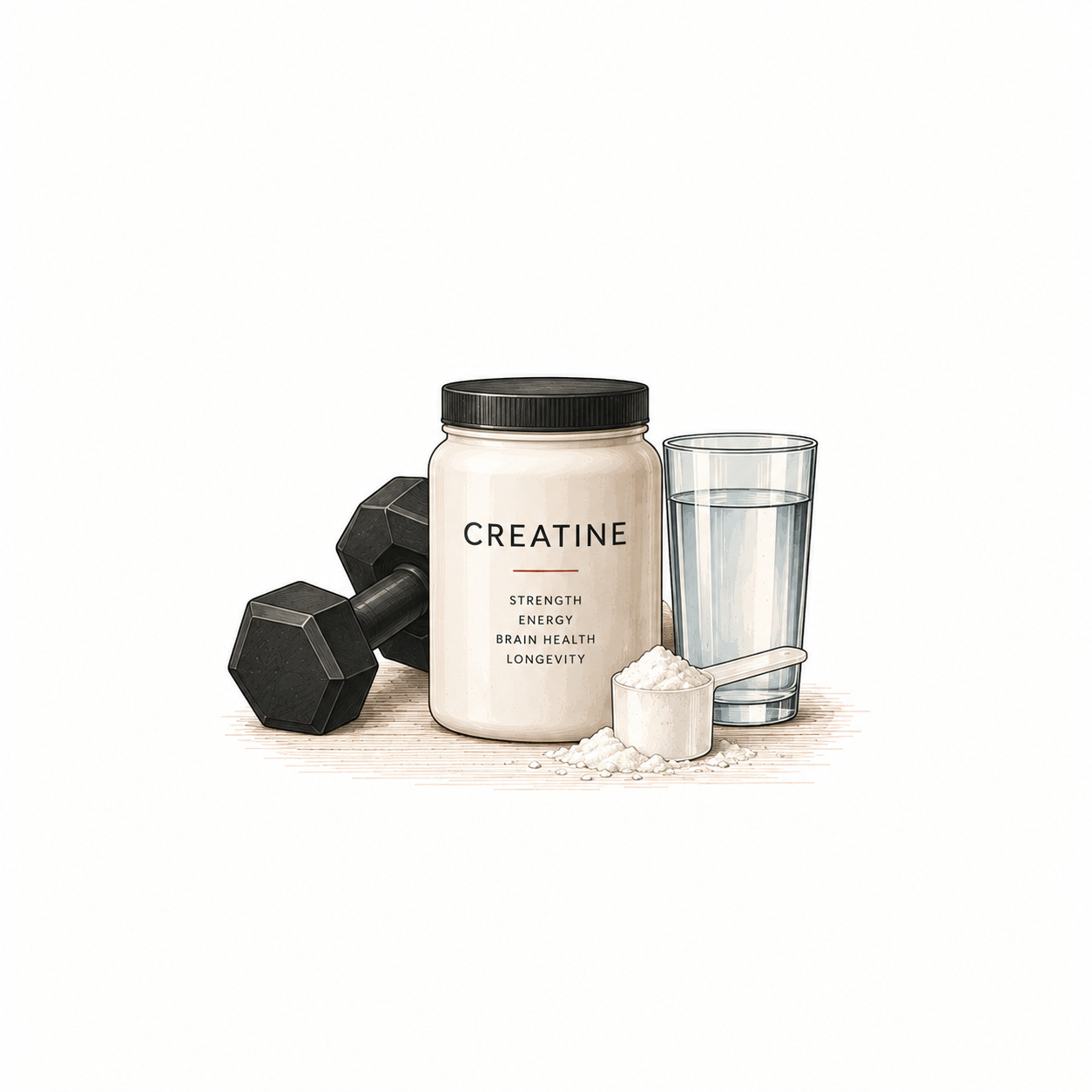
Creatine has been a fixture in gyms and locker rooms for decades. But somewhere in the last few years, it jumped categories — from a muscle-building supplement discussed mostly by athletic men, to a supposed fix for brain fog, mood, sleep deprivation, and perimenopause, discussed by everyone.
So we went looking for the real story: what does creatine actually do, what does the evidence support, and where does the marketing get ahead of the science?
The Claim
If you spend time on social media, you’ve probably seen creatine described as far more than a muscle-building supplement. The pitch has expanded to include claims that it can “boost your brain,” improve mood, concentration, and brain fog, and support bone health. One common version of the message: anyone who is tired, sleep deprived, foggy, depressed, menopausal, or perimenopausal should be taking this supplement. In some corners of the wellness and biohacking world, it’s been floated as an alternative to SSRIs, a must-have for chronically sleep-deprived parents, and a strategy for reducing the risk of Alzheimer’s disease and cognitive decline.
Why It’s Going Viral
This one is a little different from most topics we cover, because there’s a real kernel of evolving science underneath it — not just an isolated study getting overhyped.
Early creatine research, going back decades, focused almost entirely on muscle performance and was studied mostly in male athletes. Starting in the early 2000s, researchers began exploring possible neurocognitive effects. By the late 2010s and early 2020s, more research started looking specifically at women, along with mood and energy. So part of what’s happening is a genuine expansion of the evidence base — it’s just being translated into much bigger claims than the data can support.
Layer onto that a handful of familiar forces: fitness culture going mainstream, a cultural fixation on metabolic health, and real fear about losing muscle mass — whether from GLP-1-related weight loss or from the body composition shifts that come with perimenopause and menopause. Add the fact that millions of people are, for entirely valid and multifactorial reasons, tired and depressed, and a cheap, widely available supplement becomes an appealing shortcut. And in a supplement market that feels increasingly overwhelming, a lot of people are simply asking: what’s the one or two things actually worth taking?
What the Science Shows
Creatine is an amino acid derivative — not a steroid, not a protein, not a peptide. Your body makes it in the liver and kidneys, and you also get it from animal products in your diet. Its job is to help regenerate ATP, the basic energy currency your cells run on. Supplementation raises muscle creatine stores by roughly 20 to 40%, which allows for more rapid energy regeneration during high-intensity effort — more reps, more power, faster recovery between efforts.
The most well-studied and cost-effective form is creatine monohydrate; other forms marketed as more bioavailable don’t have meaningfully better evidence behind them. A loading phase (about 20 grams a day for five to seven days) saturates muscle stores faster, but most people don’t need it — a standard maintenance dose of 3 to 5 grams daily gets there gradually with less GI upset.
On muscle strength and lean body mass, the evidence is genuinely strong: decades of randomized controlled trials show creatine improves outcomes — but only when it’s paired with high-intensity training or resistance exercise. Taken without exercise, it doesn’t meaningfully change body composition.
On bone density after menopause, the picture is mixed. A smaller one-year trial (47 participants) combining creatine with resistance training found reduced bone loss at the femoral neck and greater strength gains. A larger, two-year trial (237 participants) found the combination preserved bone geometry but had no measurable effect on bone mineral density. Creatine without exercise has shown no bone benefit in either study.
On cognition, the evidence is much thinner than the marketing suggests. A 2024 review by the European Food Safety Authority looked across roughly two dozen human studies and concluded that clear evidence of cognitive benefit has not been established. The most frequently cited study — a small 2003 trial in vegetarians, who may have lower baseline creatine stores — could not be replicated in a larger 2023 study. The strongest positive signal comes from a small trial of older adults (mean age 76) given a high loading dose for two weeks, who showed improved performance on cognitive testing. That’s a meaningfully different population, dose, and duration than what’s typically being recommended to a tired 35-year-old on social media — and there’s no evidence to date that creatine reduces dementia risk.
On sleep deprivation, a couple of small studies found modest benefits to mood and certain cognitive tasks after high-dose creatine combined with significant sleep deprivation (24 to 36 hours) and exercise. These are intriguing but tiny, unreplicated studies conducted under extreme conditions — not evidence that a chronically under-slept parent should reach for creatine instead of more sleep.
On depression, the best available meta-analysis found a possible small-to-moderate benefit, but concluded the average effect was not clinically important and could be trivial or null. Importantly, the studies that did show benefit used creatine as an adjunct to treatments like escitalopram or CBT — not as a stand-alone alternative to first-line care.
One important caveat that applies across all of this: creatine is cheap, widely available, and not patentable, so there’s little financial incentive for anyone to fund the kind of large, expensive trials that would settle these questions definitively. That’s a real limitation of the evidence — it doesn’t mean the effects aren’t real, but it does mean we should hold conclusions about the newer indications loosely.
Clinical Nuance
For people doing consistent high-intensity or resistance training, there’s solid evidence that creatine meaningfully augments those results. That’s the uncontroversial part.
For nearly everything else being claimed — mood, sleep deprivation, brain fog, dementia prevention — exercise, sleep, therapy, and first-line medical treatment are still doing the heavy lifting in the underlying research. Creatine shows up as a small addition on top of those interventions, not a replacement for them.
That distinction matters clinically. There’s a real risk that overstating creatine’s benefits leads someone to delay or decline care they actually need — a sleep study, a trial of an SSRI, a course of CBT — in favor of an easier, more “natural” option that primarily has good muscle-building evidence and comparatively little else settled at this point.
There’s also a quieter harm worth naming: messaging that tells every tired, foggy, or menopausal woman she “should” be taking this adds one more item to an already overflowing list — and one more thing to feel guilty about not doing, rather than something that reliably helps.
The reassuring side is that creatine’s safety profile is genuinely excellent. Reported side effects are mostly GI upset and water retention, along with a small, expected rise in creatinine that reflects a byproduct of supplementation — not kidney damage. Clinicians who want to distinguish this from true kidney impairment can check a cystatin C level, which isn’t affected by creatine intake. As with any supplement, it’s worth choosing single-ingredient creatine monohydrate with third-party testing (look for NSF or USP certification) rather than a proprietary blend.
The Antidote
For Patients
(Gentle reminders and affirmations)
Wanting an easy fix for how tired I feel doesn’t mean I’m doing something wrong.
I don’t have to add one more thing to my list to be a responsible patient.
Creatine can help me get more out of exercise I’m already doing — it’s not a substitute for exercise, sleep, or treatment I actually need.
A supplement being safe doesn’t mean it’s the answer to everything I’m struggling with.
I can be curious about the research without feeling behind for not already taking this.
If I decide to try it, that’s a reasonable, low-risk choice — and it’s still worth telling my doctor.
For Clinicians
(Language you can borrow, tweak, or make your own)
“Creatine has really strong data for muscle strength and lean mass — if you’re doing resistance training consistently, adding it is a reasonable, low-risk choice.”
“For mood, sleep, and brain fog, the exercise, sleep, and therapy piece is still doing most of the work in the research. Creatine isn’t a replacement for those.”
“The cognition data is early and strongest in older adults taking much higher doses than most people use — I wouldn’t count on it for everyday brain fog.”
“If you decide to try it, look for single-ingredient creatine monohydrate with third-party testing, rather than a blend.”
“Let’s add this to your medication list — it can cause a small, expected bump in your creatinine, and I want to know why if I see that on your labs.”
Sources and Further Reading
International Society of Sports Nutrition position stand: safety and efficacy of creatine supplementation in exercise, sport, and medicine. https://pubmed.ncbi.nlm.nih.gov/28615996/
Effects of creatine supplementation on muscle strength gains — a meta-analysis and systematic review. https://pubmed.ncbi.nlm.nih.gov/41328071/
Short-term creatine supplementation enhances strength, reduces fatigue, and accelerates recovery in resistance-trained athletes: a double-blind, randomized, crossover trial. https://pubmed.ncbi.nlm.nih.gov/41579075/
Creatine supplementation enhances corticomotor excitability and cognitive performance during oxygen deprivation. https://pmc.ncbi.nlm.nih.gov/articles/PMC6795258/
Oral creatine monohydrate supplementation improves brain performance: a double-blind, placebo-controlled, cross-over trial. https://pmc.ncbi.nlm.nih.gov/articles/PMC1691485/
Creatine supplementation does not improve cognitive function in young adults. https://pubmed.ncbi.nlm.nih.gov/18579168/
Effects of creatine supplementation on memory in healthy individuals: a systematic review and meta-analysis of randomized controlled trials. https://pmc.ncbi.nlm.nih.gov/articles/PMC9999677/
The effects of creatine supplementation on cognitive performance — a randomised controlled study. https://pubmed.ncbi.nlm.nih.gov/37968687/
Creatine supplementation and cognitive performance in elderly individuals. https://pubmed.ncbi.nlm.nih.gov/17828627/
Single dose creatine improves cognitive performance and induces changes in cerebral high energy phosphates during sleep deprivation. https://pmc.ncbi.nlm.nih.gov/articles/PMC10902318/