

Prefer to listen to a human conversation?
A patient messaged Sonia in a panic: she’d broken out in a rash “all over her face.” It was red, itchy, bumpy, and sudden. Her skin had been clear before. She was worried it was hormonal. Or something she ate. Or “something going on internally.”
When she came in, the pattern was classic: the redness and irritation sat exactly where you’d expect a new face product to land—cheeks, around the mouth, along the jawline. It looked like allergic contact dermatitis.
Sonia asked the question that often unlocks the mystery:
“Have you used anything new?”
The patient paused, then said yes—but it couldn’t be that. Because the new product was “clean.” Natural. Safer.
She’d recently thrown out her old skincare to make the switch to cleaner products. The new moisturizer was made from ingredients that felt almost comforting in their simplicity: beef tallow, olive oil, lavender oil, tea tree oil, beeswax.
And it had completely wrecked her skin.
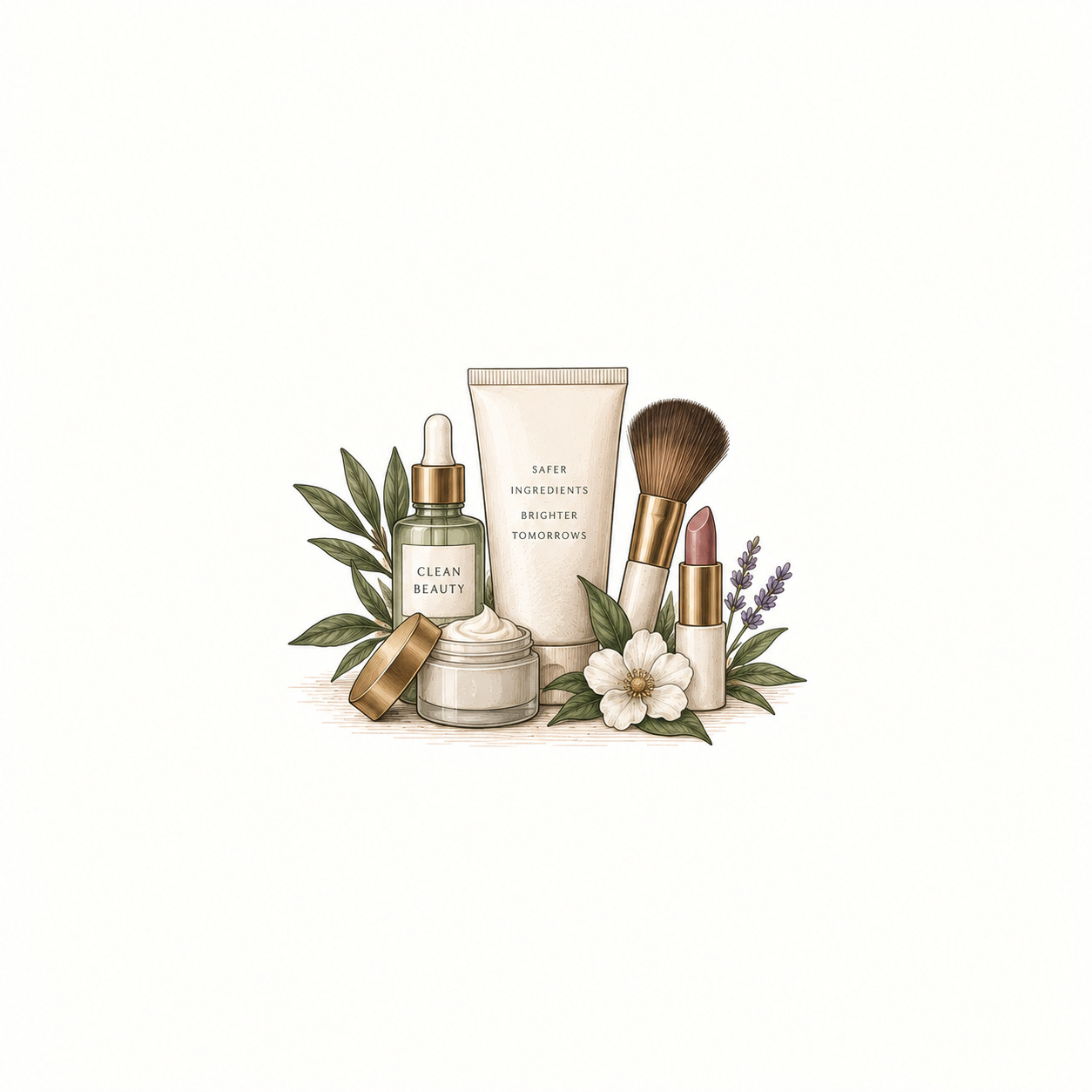
That visit ended up being a perfect snapshot of the clean beauty conversation: a movement that often starts with a legitimate concern—I want products that are safer for my body—but can quickly drift into a confusing, moralized, anxiety-provoking maze of ingredient lists, fear-based marketing, and false certainty.
So let’s slow down and ask the bigger question:
Should we all be switching to clean beauty?
The claim
The clean beauty message usually goes something like this:
Conventional beauty and personal care products contain “toxins.” Clean products don’t. Therefore clean products are safer—less irritating, less hormonally disruptive, less carcinogenic, and better for you in the long run.
Sometimes the claim expands into a whole constellation of promises: “clean” also means more ethical, more sustainable, cruelty-free, better for the environment, better for your hormones, better for your skin.
And it can feel like the stakes are high.
Not just “what moisturizer should I use,” but “am I harming myself by using what everyone else uses?”
Why this is so viral
Here’s the part we want to validate immediately: there is a reason people are worried.
There are historical examples of personal care products turning out to be harmful, sometimes after being marketed as safe for decades. Many of us remember the headlines about talc powders and ovarian cancer risk, or the stories about skin-lightening products containing mercury.
At the same time, there’s been a lot of public conversation about rising rates of certain cancers in younger people. The medical community is still working through the “why”—and the likely answer is that it’s multifactorial. But when science doesn’t yet have satisfying explanations, our brains search for something we can control.
That’s where clean beauty fits perfectly.
It offers a simple, consumer-friendly solution:
If you switch your products, you reduce your risk.
It feels empowering. It feels protective. It feels like taking action in a world that often feels out of control.
And the marketing is skilled. It often frames clean beauty as advocacy—especially for women and children—because those groups have historically been underprotected and undertested in consumer product safety.
So yes: the emotional logic behind clean beauty is understandable. Most people aren’t trying to be “extreme.” They’re trying to feel safe.
The nugget of truth
There are ingredients found in personal care products that have been linked—through a mix of laboratory studies, animal studies, and human epidemiology—to potential health effects.
Some of the concern centers on endocrine-disrupting chemicals: substances that may mimic, block, or interfere with hormonal signaling.
And here’s where the conversation gets tricky, because the science isn’t simple—and it isn’t settled in the way many social media posts suggest.
In traditional toxicology, we’re taught a principle that’s worth keeping: the dose makes the poison. Whether something is harmful depends on the concentration, the route of exposure, the frequency of use, the timing (pregnancy, infancy, puberty), and the person’s biology.
But endocrine disruptors have challenged some of the clean lines toxicologists like to draw. Some experts argue that hormonal systems can be sensitive to small exposures at key developmental windows—and that we may not fully understand the long-term effects yet.
That disagreement is real.
It’s not “doctors denying science” versus “clean beauty telling the truth.” It’s a genuine scientific debate about how to interpret imperfect data in a world where exposures are widespread and hard to isolate.
The piece most people aren’t told: “clean” doesn’t mean what you think it means
One of the biggest problems with clean beauty isn’t that people want safer products. It’s that the word “clean” itself is not regulated.
It isn’t a scientific label. It’s a marketing label.
A brand can call a product “clean” without proving anything about safety, hormonal effects, cancer risk, or irritation risk. Sometimes “clean” simply means “free from the handful of ingredients that consumers currently fear most.”
Which leads to the first big paradox:
A product can remove one ingredient you’re worried about—and replace it with something else that is less studied, more allergenic, or simply differently risky.
Parabens are a good example.
Parabens are preservatives. Their job is to prevent bacteria and mold from growing in products that sit in warm bathrooms and get repeatedly touched by hands. They’re used because they work—and because they’re relatively non-allergenic compared to many alternatives.
If a company removes parabens to satisfy consumer demand, it still has to preserve the product. That replacement might be a preservative that triggers more contact dermatitis. Or a botanical ingredient that is “natural” but highly sensitizing. Or a newer preservative with less long-term data.
And we don’t always notice those tradeoffs until something goes wrong—like a patient who switches to “natural” and ends up inflamed, itchy, and miserable.
“But I’d rather be safe than sorry”
This is the sentence we hear all the time, and we get it. It makes emotional sense.
But “safe” is not a single switch you flip. It’s a set of tradeoffs.
If you remove preservatives, you increase the risk of microbial contamination. That might not feel dramatic until you realize that contaminated eye makeup has caused serious infections in real people.
If you replace “chemicals” with essential oils, you may reduce one category of concern and increase another: essential oils are a common cause of allergic contact dermatitis, and certain oils (including lavender) have been implicated as endocrine disruptors in children.
So the question isn’t “is natural safer?” The question is:
Safer in what way, for whom, at what dose, and compared to what alternative?
The apps don’t solve this
A lot of people try to navigate clean beauty with ingredient-scanning apps that score products as green/yellow/red.
We understand why: when you feel overwhelmed, you want a simple tool that tells you the answer.
But these apps often oversimplify the science by treating ingredients as inherently “good” or “bad” without accounting for concentration, typical use, formulation, route of exposure, and the quality of evidence.
They also aren’t neutral. Many monetize through affiliate relationships or product recommendations—meaning the “safer” product is sometimes also the product they benefit from you buying.
That doesn’t mean every recommendation is wrong. It means you should be cautious about outsourcing your health anxiety to a scoring algorithm.
So…should you switch?
Here’s the most honest answer we can offer:
If you like a product that’s labeled “clean,” you can afford it, and it doesn’t increase your anxiety or trigger obsessive researching and scanning—there is nothing wrong with choosing it.
But “clean” is not a guarantee of safer. And the individual health impact of switching a few personal care products is likely small—especially compared to well-established risk reducers like not smoking, limiting alcohol, getting HPV and Hep B vaccination, eating fiber-rich foods, and using sunscreen consistently.
This is not the same category of risk as tobacco. It’s not the same category of risk as heavy alcohol use. It’s not the same category of risk as uncontrolled hypertension.
And that matters, because clean beauty marketing often implies you’re making a life-or-death decision at the checkout line.
You’re not.
The part that gets missed: this is a public health problem, not a personal failing
U.S. cosmetic regulation is limited compared to other industries. The FDA does not pre-approve cosmetics the way it approves medications, and companies largely bear responsibility for ensuring safety. That reality contributes to distrust, and it isn’t unreasonable for consumers to want stronger oversight.
But when we respond to systemic problems with purely individual solutions—“just buy the clean version”—we often end up with the worst of both worlds:
people spending more money for uncertain benefit
people feeling guilty if they can’t afford the “right” products
people feeling constant low-grade fear about what they’re using
and the broader system staying largely unchanged
If we want meaningful change, it requires stronger research funding, stronger regulation, and less reliance on marketing as our safety net.
A note about “clean living” and why the word matters
Clean beauty often travels with clean eating, clean home, clean living.
And we want to name something gently: “clean” is not a neutral word.
It implies purity. It implies morality. It implies that people who don’t do it are careless—or “dirty.” And on social media, those ideas can slide quickly into shame, fear, and sometimes more extreme content.
This doesn’t mean everyone interested in clean beauty is participating in purity culture.
It does mean we should stay aware of how easily anxiety + algorithms can escalate.
If your search starts with “safe sunscreen” and ends with “don’t trust doctors,” that’s not because you’re irrational. It’s because the platform is optimized to serve you more intense versions of what you engaged with.
The Antidote
For Patients
It makes sense that I want safer products.
“Clean” is a marketing term, not a medical guarantee.
Natural doesn’t automatically mean safer.
If there is risk here, it’s likely small.
I don’t have to fix a public health issue with my shopping cart.
The biggest drivers of my health aren’t in my moisturizer.
For Clinicians
“I completely understand why you’re worried — there are real gaps in regulation.”
“If there are harms from these ingredients, they’re likely subtle and population-level.”
“‘Clean’ isn’t a regulated term, so it doesn’t necessarily mean safer.”
“When one ingredient is removed, it’s usually replaced with something else — and that swap isn’t always lower risk.”
“Let’s also focus on the prevention strategies we know clearly reduce cancer risk.”
Sources and Further Reading
Amended Safety Assessment of Parabens as Used in Cosmetics https://www.cir-safety.org/sites/default/files/Parabens_0.pdf
History- Clean Living Movement https://en.wikipedia.org/wiki/Clean_living_movement
The Hoax of Clean Beauty and Associated Allergens https://link.springer.com/article/10.1007/s13671-023-00399-4
Natural Is Not Always Better: The Prevalence of Allergenic Ingredients in “Clean” Beauty Products https://www.liebertpub.com/doi/abs/10.1097/DER.0000000000000863
Natural Does Not Mean Safe—The Dirt on Clean Beauty Products https://jamanetwork.com/journals/jamadermatology/fullarticle/2751513
Instagram accounts to follow: