

Prefer to listen to a human conversation?
Paid subscribers: Visit our Handouts section for the TL;DR and claim CME here.
Patient Story
Most of our episodes start with a patient question. This one started with our colleagues. When we asked a large national group of physicians which social media health trends they most wanted us to dig into, red light masks were near the top of the list. And to be honest, we don’t think it was only so they’d have something to tell their patients.
Around the same time, Sonia had a patient message her with a very practical question: her husband had just had a mole removed from his face, and she wondered whether he should borrow the LED mask she’d been using for her acne. Sonia’s reply was the most honest one available: “Hold that thought. I have to do research for this episode.”
So we did the research. And for once, we came out of it a little less skeptical than we went in.
The Claim
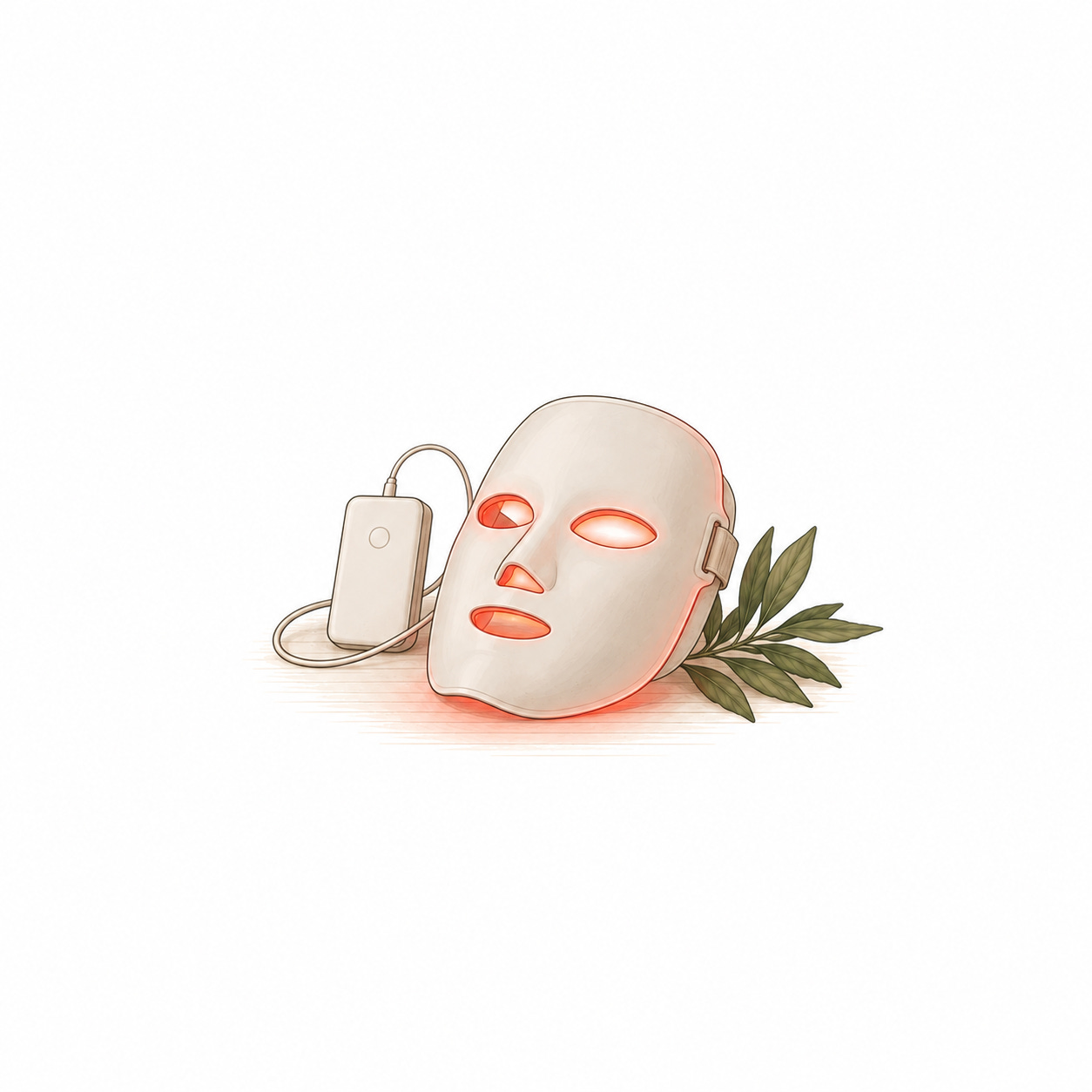
If you spend time on social media, you’ve probably seen someone wearing a glowing red mask while answering emails, walking on a treadmill, or filming a story. Depending on where you scroll, it’s either a serious skincare tool or a running joke about moms trying to do six things at once.
The pitch is that LED masks are a non-invasive, no-downtime, lower-cost way to treat acne and signs of aging. Online, they’re said to “snatch” your face, tighten skin, shrink pores, fade pigmentation, smooth wrinkles, boost collagen, improve lymphatic drainage, reduce inflammation, detoxify, and make your other skincare products work better. That’s a long list for one piece of plastic. It sounds a little like magic, and most things that sound like magic deserve a closer look.
Why It’s Going Viral
Some of this is no mystery. Nobody wants to feel like they’re aging faster than they’d like, and anti-aging products will always find an audience. But a few things about this moment make red light masks especially appealing.
We see our own faces far more than we used to. Years of video calls, front-facing cameras, and filtered and AI-smoothed images have quietly moved the target. The ideal face keeps getting smoother, and as Botox has become common among younger women, it can start to feel less acceptable to simply have lines. For people who don’t want injections, can’t afford them, or just aren’t ready, a mask can feel like a gentler middle path.
Masks also seem safe. There’s no drug, no needle, no downtime, and no long list of ingredients to worry about, which fits neatly with a growing distrust of pharmaceuticals and a preference for anything that feels “natural.” Compared with an in-office laser or a year of injectables, a few hundred dollars can look like a bargain.
Then there’s time. We have a theory about why so many women physicians were curious: you can wear the mask while doing something else. It doesn’t feel like one more thing to make time for. It’s ten minutes you were going to spend charting or watching a show anyway. For people who already feel stretched thin and under pressure to look rested, a self-care step that doesn’t cost extra time is very appealing. It also fits right into the culture of the skincare “stack” and constant optimization that we talk about a lot on this show.
Heavy influencer marketing plays a role too. We get regular requests to promote these masks through affiliate links, despite not being influencers. The glowing skin you see next to a mask on Instagram may also come with lasers, facials, professional products, good lighting, and a filter.
And there’s a real reason beneath all of it: the research on light therapy has grown a lot. Publications on LEDs in dermatology have more than doubled since 2010. Some of the excitement reflects real evidence, not just hype.
What the Science Shows
Whenever we look at a trend, we try not to stop at “is it good?” We ask: good for what, in whom, and based on what strength of evidence? We also look at whether the evidence has climbed the whole ladder. Is the mechanism biologically plausible? Does it work in cells and animals? Does it work in people, and is the effect big enough to matter? Much of the wellness world stops at the first rung. Red light masks, to their credit, reach all of them. What’s left to argue about is how strong the human studies are.
How it works. Red light masks belong to a broader category of LED (light-emitting diode) devices that work through photobiomodulation. Light is absorbed by an enzyme in your mitochondria (cytochrome c oxidase), which affects energy production and activates signaling that can stimulate fibroblasts, the cells that make collagen. Some wavelengths also have antibacterial effects against C. acnes, reduce oil production, and calm inflammatory signaling. We do see these effects in lab and animal studies.
Color matters. Every red light mask is an LED mask, but not every LED mask is red. Red light (about 630 to 660 nm) reaches the dermis and is the most studied for wrinkles. Near-infrared (about 830 to 850 nm) goes a bit deeper and is often paired with red. Blue light (about 415 nm) stays near the surface and is the one used for acne. Many masks combine wavelengths or let you switch between them, so the first question is what you’re actually trying to treat.
For adults with early wrinkles. The strongest study we found was a 2025 randomized, double-blind, sham-controlled trial from Korea. It included 60 adults of Asian descent, ages 30 to 65, most of them women, who used a home red plus near-infrared device (630 and 850 nm) or an identical-looking sham for 9 minutes a day, 5 days a week, for 12 weeks. At week 12, independent raters judged that crow’s feet had improved in about 86% of the active group, compared with about 17% of the sham group. The standardized before-and-after photos were genuinely impressive. A few caveats: the trial was funded by the device’s manufacturer, it focused only on crow’s feet, the paper describes the device as including a “medical laser” component (so it may not match what’s sold online), and the participants’ own ratings of improvement were not significantly different between groups.
Another randomized trial in 52 women found that daily red (660 nm) and white LED home devices both improved wrinkle measurements over 12 weeks. The red group did slightly better, but the difference wasn’t statistically significant, and there was no sham group.
For adults with mild to moderate acne. In a 2015 trial, 41 adults were randomized to a blue light home device or a control. After 12 weeks, inflammatory lesions dropped by about 50% in the treatment group and rose by about 2.5% in the control group, with no side effects reported. That’s in the same range we’d expect from first-line topical treatments. But the study was small, two investigators worked for the manufacturer, and Rebecca’s question on the episode turned out to matter: the light was used together with the company’s own creams, so we can’t credit the improvement to the light alone. A 2023 meta-analysis of 31 studies found that red and blue LED light both meaningfully improved acne, and an in-office study found once-weekly blue-red sessions worked about as well as twice-weekly ones.
The bigger picture. Reviews of this field keep returning to the same limitations: small studies, short follow-up, methodologic flaws, wide variation in devices and doses, and a lot of industry funding. Something real seems to be happening. How much, in whom, and with which device is still not settled.
Clinical Nuance
“Science-backed” is a common marketing term, but this can mean anything from a well-run trial to a story built from a few biology terms. With masks, the details matter most.
What are you actually getting? Beyond wavelength, the key number is dose. Irradiance is the light’s power, measured in milliwatts per square centimeter (mW/cm²). Fluence is the total dose, measured in joules per square centimeter (J/cm²): irradiance multiplied by time. In-office devices may deliver around 50 to 80 mW/cm², while a home mask might deliver around 10. That doesn’t make home masks useless. The crow’s-feet trial used a low-output device. It does mean they need to be used consistently, usually most days for two to four months. Effective studies generally fall in the range of roughly 6 to 80 mW/cm² and 8 to 126 J/cm². Many commercial masks don’t publish any of these numbers, and measured output varies widely between products. The cheapest masks, in particular, often list only general benefits of light therapy and nothing specific.
More is not better. Light therapy appears to have a biphasic dose response: past a certain point, more light can blunt the benefit. So the “I have an event tomorrow, I’ll wear it for an hour” plan doesn’t help. Some sources even suggest spacing sessions about 72 hours apart, though there’s no consensus. A device with a fixed, built-in session time is a good sign.
Low risk isn’t the same as no risk. Side effects in studies are mostly mild redness, dryness, and eye irritation. In 2019, Neutrogena recalled its light therapy acne mask, saying that people with certain underlying eye conditions, or who take medications that increase eye sensitivity to light, faced a theoretical risk of eye injury. Built-in eye protection is worth looking for. Retinoids, some acne medications, and other photosensitizing drugs or topicals can make skin more reactive. There’s no safety data in pregnancy, and at least one popular brand advises against use while pregnant, trying to conceive, or breastfeeding. That same brand linked to a list of other contraindications that, despite many clicks, Sonia could not get to open. For patients with a history of skin cancer, including melanoma, we didn’t find data either way, which is a good reason to slow down and check with a dermatologist.
Regulation is light, too. Some masks are FDA-cleared, which adds a basic layer of review but doesn’t prove they work. Home cosmetic devices as a category are loosely regulated.
Cost vs benefit is a real consideration. Prices we saw ranged from the mid-$300s to well over $1,500, and devices eventually break down or get replaced by the next model.
Don’t skip the proven options. There are no good head-to-head studies of masks versus retinoids for aging, or versus benzoyl peroxide and topical retinoids for acne. The topicals have decades of data, a well-understood safety profile, and a much lower price. That said, retinoids can be drying and irritating, and not everyone tolerates them. For some people, a mask is perhaps an alternative to consider.
Know yourself, and your patient. Neither of us is likely to use one. Sonia can picture impulse-buying a mask after spotting a new line and then forgetting about it once results don’t show up right away. Rebecca’s commitment to skincare is nonexistent- she has had a full tube of retinol on her bathroom sink for over a year that has probably expired. But plenty of patients genuinely enjoy their skincare routine. If lying down with a mask after an eight-step routine feels like real self-care, that’s a perfectly good reason. Our job is to avoid projecting our own values onto patients, whether we’re tempted to say “that’s a TikTok fad” or “these are great, here’s my affiliate link.” A patient who asks deserves a real answer: what the evidence shows, what to look for, how to use it safely, and which alternatives exist. And if we don’t know, we can say so, look into it, or refer them to a dermatologist.
The Antidote
Affirmations for Patients
My face is allowed to change. Aging isn’t a problem I’m failing to solve.
I don’t have to make every minute productive, including the minutes I spend caring for myself.
If a routine feels like care, I can enjoy it. If it feels like another job, I can let it go.
I can ask what something actually does before I spend money on it.
Simple, well-studied options aren’t lesser options.
Whatever I choose for my skin, it’s my choice to make.
Language Clinicians Can Use
“I’m really glad you asked. There’s actually some data on these, so let’s talk about what they can and can’t do.”
“What are you hoping it helps with? Wrinkles and acne respond to different colors of light, so that changes which mask makes sense.”
“If you buy one, look for a mask that lists its wavelength and output. A lot of them don’t, and that’s a reason to pass.”
“More isn’t better with these. Stick to the session time it comes with, and give it a couple of months.”
“We don’t have head-to-head data against retinol, but retinol has decades of research behind it and costs a lot less. If retinol bothers your skin, a mask could be a reasonable thing to try.”
“Before you start, let’s check whether any of your medications or skin products make you more sensitive to light, and make sure your eyes are protected.”
“I don’t know the answer for your specific situation. Let me look into it, or refer you to a dermatologist who may know this data better.”
Sources
Maghfour J, Ozog DM, Mineroff J, Jagdeo J, Kohli I, Lim HW. Photobiomodulation CME part I: Overview and mechanism of action. Journal of the American Academy of Dermatology. 2024. https://pubmed.ncbi.nlm.nih.gov/38309304/
Glass GE. Photobiomodulation: The clinical applications of low-level light therapy. Aesthetic Surgery Journal. 2021. https://pubmed.ncbi.nlm.nih.gov/33471046/
Nitayavardhana S, Manuskiatti W, Cembrano KAG, Wanitphakdeedecha R. A comparative study between once-weekly and alternating twice-weekly regimen using blue (470 nm) and red (640 nm) light combination LED phototherapy for moderate-to-severe acne vulgaris. Lasers in Surgery and Medicine. 2021. https://onlinelibrary.wiley.com/doi/10.1002/lsm.23388
The application of light emitting diode (LED) in cosmetic dermatology. Photodermatology, Photoimmunology & Photomedicine. https://onlinelibrary.wiley.com/doi/10.1111/phpp.70041
Park SH, Park SO, Jung JA. Clinical study to evaluate the efficacy and safety of home-used LED and IRED mask for crow’s feet: A multi-center, randomized, double-blind, sham-controlled study. Medicine. 2025. https://pubmed.ncbi.nlm.nih.gov/39960921/
Nam CH et al. The efficacy and safety of 660 nm and 411 to 777 nm light-emitting devices for treating wrinkles. Dermatologic Surgery. 2017. https://pubmed.ncbi.nlm.nih.gov/28195844/
Ngoc LTN, Moon JY, Lee YC. Utilization of light-emitting diodes for skin therapy: Systematic review and meta-analysis. Photodermatology, Photoimmunology & Photomedicine. 2023. https://onlinelibrary.wiley.com/doi/10.1111/phpp.12841
Ash C, Harrison A, Drew S, Whittall R. A randomized controlled study for the treatment of acne vulgaris using high-intensity 414 nm solid state diode arrays. Journal of Cosmetic and Laser Therapy. 2015. https://www.tandfonline.com/doi/full/10.3109/14764172.2015.1007064
Neutrogena recalls light therapy masks, citing risk of eye injury. The New York Times. 2019. https://www.nytimes.com/2019/07/18/style/neutrogena-light-therapy-mask-recall.html