

Prefer to listen to a human conversation?
When Rebecca was a medical student on a surgery rotation, her days started at 4 a.m. and often ended after 7 p.m. There were no predictable breaks—just a constant scramble to eat when and if you could.
Her co-student on the rotation was deeply committed to “clean eating.” During their ten-minute lunch breaks, they’d complain about the hospital cafeteria being full of “processed crap.” They refused to eat anything available except steamed green beans—the only food they deemed “clean” enough. They commented on the granola bars Rebecca carried in her white coat pockets so she could eat something—anything—between cases.
That day, after nearly fifteen hours on their feet, they had eaten only green beans.
What’s the Claim?
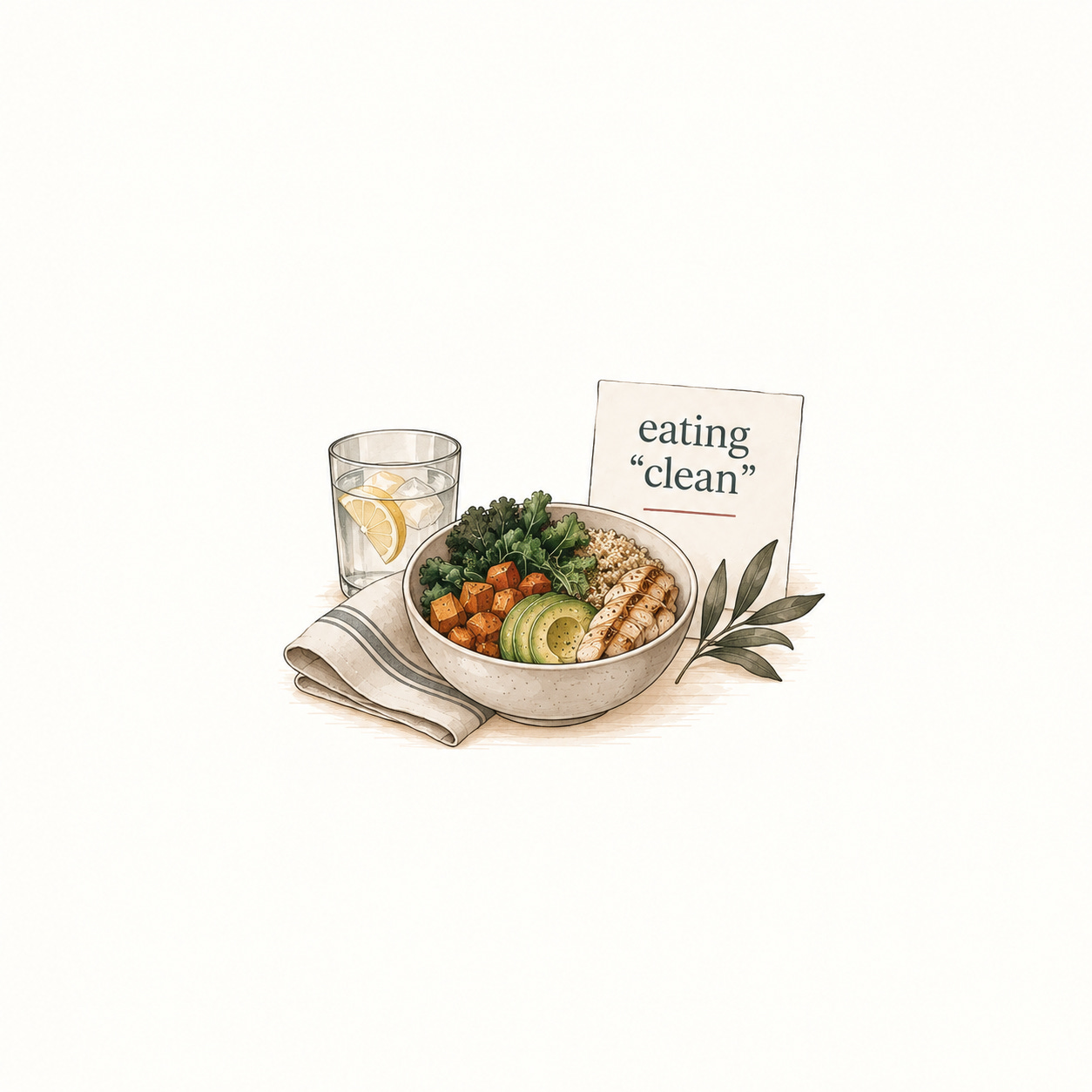
Across social media, influencers and even some health professionals promote “clean eating” as a path to better health, weight loss, and disease prevention.
There’s no single definition, but it usually means:
Eating mostly “whole” foods
Avoiding additives, preservatives, or “toxins”
Demonizing “processed” foods
Today, we’re less interested in debating individual ingredients and more interested in the concept itself: clean vs. unclean eating—and why that framing can be harmful and counterproductive.
Why Is It So Viral?
Despite the lack of a clear definition, “clean eating” has a very positive reputation.
A 2020 study of U.S. adolescents and emerging adults found that:
71% viewed clean eating as healthy
41% said they would probably try it
Definitions varied widely, but dietary avoidance and restriction were common
Willingness to try clean eating was significantly higher among women
People want to live long, healthy lives. Many have watched loved ones suffer from chronic disease. In a world where so much feels out of our control, food can feel like one of the few things we can control.
Nutrition is also deeply confusing. Advice changes constantly, formal education is limited, and reliable guidance can be hard to access.
Layer on top of that:
A culture that stigmatizes higher-weight bodies
“Good vs. bad” food messaging we absorb from childhood
A wellness industry that profits from fear, purity, and weight loss
And suddenly, “clean eating” doesn’t just feel intuitive—it feels virtuous.
In The Gospel of Wellness, journalist Rina Raphael describes how values once tied to religion—purity, discipline, moral worth—have migrated into wellness culture. Social psychologist Jonathan Haidt makes a similar point in his TED Talk on moral psychology, noting how food has become deeply moralized, especially among women.
An essay titled Purity Culture, Diet Culture, and Where They Intersect puts it this way:
“Purity… expresses itself in our culture through female bodies. It asks those with female bodies to restrain, refrain, limit… to make ourselves smaller—physically and in terms of life experience.”
That framing helps explain why “clean eating” is so often marketed to women—and why it can feel both aspirational and suffocating.
What’s the Nugget of Truth?
Nutrition matters. Different foods have different nutrient density. Diet plays a major role in health.
A diet made up mostly of highly processed foods is more likely to be low in fiber and key micronutrients. Incorporating a wider variety of foods can meaningfully improve health outcomes.
That part is real.
The problem is what gets layered on top of it.
The Facts (With Context and Nuance)
Food processing is not inherently bad. Processing:
Improves shelf stability and safety
Reduces food waste
Makes food more affordable and accessible
Allows large populations to be fed consistently
Processing can be as simple as freezing vegetables—or as complex as engineering snack foods to maximize crunch, salt, sweetness, and reward.
Food companies are incentivized to design products that bypass normal satiety cues, encouraging us to eat more. That matters—but it’s not the same as saying processed food is inherently “bad” or unsafe.
Many people face real barriers to eating a balanced diet:
Cost and food deserts
Limited time and demanding work environments
Lack of nutrition education
Aggressive and misleading food marketing
It is absolutely possible to eat a nutritionally adequate, balanced diet that includes processed foods—even foods with additives and added sugar.
What Does the Data Say?
According to the CDC, about 60% of the average American diet comes from processed foods. That makes strict “clean eating” not just aspirational—but often unrealistic.
Multiple studies show a consistent pattern:
People who follow clean eating advice may meet certain dietary guidelines more often
They also show significantly higher levels of dietary restraint (defined as “ obsessive effort to restrict and control calorie intake and food choices”)
Dietary restraint is strongly linked to disordered eating behaviors
Studies have also found associations between clean eating beliefs and:
Orthorexia nervosa symptoms
Eating disorder symptoms
Thin-ideal internalization
Body image distress
In other words: the same framework that looks healthy can quietly increase risk—especially for women and vulnerable populations.
What Can We Learn From This?
“Clean eating” has no standard definition and is not a medical recommendation.
While the underlying desire—to nourish your body—is valid, the clean/unclean framing:
Moralizes food unnecessarily
Ignores context and access
Is unrealistic for many people
Can increase fear, guilt, and rigidity around eating
For some, it’s not neutral advice—it’s actively harmful.
The Antidote
For Patients:
(Gentle reminders and affirmations)
I don’t have to earn health through purity.
Food isn’t a measure of my character.
One meal doesn’t define my health.
My body needs enough food, not perfect food.
Convenience foods are not a personal failure.
If a rule makes my world smaller, it’s not serving me.
I’m allowed to unfollow content that makes me feel worse.
For Clinicians:
(Language you can borrow, tweak, or make your own.)
“When you say ‘clean eating,’ what does that mean to you?”
“What foods do you actually have access to—time-wise and money-wise?”
“Are any of these rules making it harder for you to eat enough?”
“Have you ever noticed anxious or restrictive patterns around food?”
“Let’s aim for nourishment and sustainability, not purity.”
“Would it feel helpful to involve a dietitian or therapist here?”
Sources & Further Reading
“It’s Healthy Because It’s Natural.” Perceptions of “Clean” Eating Among U.S. Adolescents and Emerging Adults
https://pubmed.ncbi.nlm.nih.gov/32517342/The Dirt on Clean Eating: Dietary Intake, Restrained Eating, and Opinions About Clean Eating Among Women
https://pmc.ncbi.nlm.nih.gov/articles/PMC6164197/Is #cleaneating a Healthy or Harmful Dietary Strategy?
https://pmc.ncbi.nlm.nih.gov/articles/PMC6545628/“Eat Clean, Train Mean, Get Lean”: Body Image and Health Behaviors on Instagram
https://pubmed.ncbi.nlm.nih.gov/35644096/CDC: Processed Foods and Dietary Intake
https://www.cdc.gov/pcd/issues/2018/17_0265.htmJonathan Haidt – The Moral Roots of Liberals and Conservatives (TED Talk)
https://www.ted.com/talks/jonathan_haidt_the_moral_roots_of_liberals_and_conservativesPurity Culture, Diet Culture, and Where They Intersect
https://www.pastemagazine.com/food/diet/purity-diet-culture-roe-v-wadeFour Simple Questions Can Help Screen for Eating Disorders
A Nuanced Look at Ultra-Processed Foods – Your Local Epidemiologist (Guest: Megan Maisano, MS, RDN)
Instagram/Substack accounts to follow
